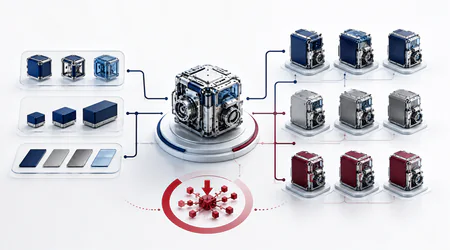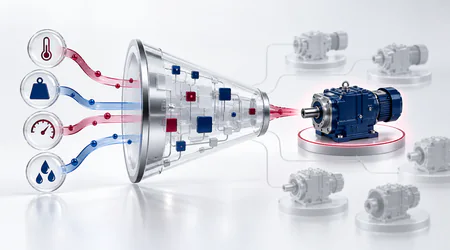
A product configurator is software that helps users define a product by applying encoded compatibility and business rules. It checks these rules in the background and returns a specification, often with a type code and a bill of materials. The result is only as reliable as the product model and rule set maintained in the system. For manufacturers with multiple variants, it decides whether an inquiry becomes a reliable quote in minutes or only after several rounds of questions to engineering.
What is a product configurator?
The core is the rule logic. A form accepts any input. A configurator, by contrast, knows that a particular motor requires stronger cooling, that two options exclude each other and that a combination may be buildable but not approved. The lexicon of the German Informatics Society mentions, as one option, marking invalid options with an explanation and suggestions for resolving the conflict.
Many names are in use: variant configurator, sales configurator, quote configurator, 3D configurator. These terms describe different aspects of a configurator. “Sales” refers to its use in the sales process, “3D” to its visualization capabilities and “variant” to the configuration of product variants. A single system may combine several of these, for example a sales configurator with 3D visualization.
How a product configurator works
Two building blocks produce the result. The product model describes what a product consists of: attributes with units, allowed values, assemblies and options. The rule set defines what fits together. Typical rule types are exclusions (“option A not with B”), requirements (“outdoor use always needs at least IP65”), derivations (power and speed determine the gearbox size) and defaults.
The result is a complete, consistent configuration. Depending on the system, it produces a type code, an item number, a bill of materials for the ERP or a record for the quote. Capable configurators do not need to enforce a fixed order of inputs. Users can start with the dimensions or with the color, and the rule set keeps the configuration valid at every step.

What types of product configurators are there?
Three classifications are common.
By modeling approach
This is about how the rule set is represented technically. The German Informatics Society lexicon distinguishes rule-based, model-based and case-based approaches. Case-based systems, which start from similar earlier configurations, are rare in industry. Constraint-based systems are a common form of the model-based approach. In practice, manufacturers mostly encounter these four forms.
| Approach | Principle | Suitable for |
|---|---|---|
| Variant table | All valid combinations are listed in a table | Few attributes, manageable variant space |
| Decision tree | Questions in a fixed order lead to the variant | Needs assessment, simple product ranges |
| Rule-based | If-then rules check every input | Medium complexity, readable rules |
| Constraint-based | Conditions describe what must hold, the engine finds valid solutions | Large variant spaces, free input order |
Variant tables quickly reach their limits. Just seven attributes with five values each add up to 78,125 combinations. Rule-based and constraint-based systems do not have to list these combinations. The difference lies in direction. An if-then rule works from cause to effect and often depends on the order of inputs. A constraint, by contrast, describes a condition that holds in every direction: if someone picks the gearbox first, the system narrows down the matching motors just as it would the other way around.
By channel and capability
Configurators can be classified along several independent dimensions. By audience and channel, they may support internal or field sales, or offer web-based self-service to customers and distributors. These uses can overlap: sales staff may use the same web configurator as customers. Separately, a configurator may provide 3D visualization and integrate with an ERP system to transfer validated configurations or generate production data, such as a bill of materials. Companies may combine these capabilities and, where appropriate, share a common product model and rule set.
Functional or parametric configuration
Functional configuration changes a product’s equipment or performance, for example by selecting a different drive or control unit. In parametric configuration, users specify dimensions within defined limits, as with cut-to-size products. The configurator calculates the resulting design and, where applicable, derives the required components and bill of materials.
When you need a product configurator
Whether a configurator pays off depends heavily on the order type. In pick-to-order, stocked components are simply put together, and a configurator is often not needed at all, as long as no bundle or accessory rules apply. With configure-to-order and assemble-to-order, real configuration tasks arise because components depend on each other. In make-to-order, the manufacturer produces to specific customer requirements, as the Gabler business lexicon puts it. In engineer-to-order, part of every order is newly engineered. There, the configurator can cover the standard share but does not replace custom engineering. A detailed table of these classes and their suitability for quoting processes is in the article on CPQ.
Examples from B2B and B2C
In B2C, configurators are familiar from cars, kitchens or bicycles. Customers put the product together themselves, and the configurator prevents impossible combinations.
In B2B, quoting is what matters most. A switchboard manufacturer combines protective devices, terminals and enclosures that have to fit together electrically and physically. A window manufacturer works parametrically: width, height, opening type and glazing determine hardware and profile. The article on PIM and BIM covers the additional data such manufacturers need to supply to designers. In drive technology, the configurator derives the right combination of motor, gearbox and inverter from load, speed and environment. What all cases have in common is that the knowledge behind them used to sit in the heads of a few experts.
Benefits, and how to measure them
Reliable figures are rare because the effect of a configurator is hard to separate from other measures. A study by the Technical University of Denmark (Hvam et al., 2013) examined four companies. Lead time for quotes and specifications fell by 94 to 99 percent, and effort by 50 to 95 percent. In one case, preparing quotes and bills of materials for electrical switchboards went from three to five days to ten minutes. These effects in the quoting process could be clearly attributed to the configurator. According to the authors, that was not possible for broader effects such as revenue or costs.
For your own project, your own measurement is what counts. Useful metrics are the time from inquiry to a valid specification, the share of configurations that need no input from engineering, the abandonment rate in self-service and the effort needed to add a new option to the rule set. Record these values before the project starts. Otherwise, there is nothing to compare against later.
What data a product configurator needs
A configurator is only as good as the product model beneath it. Attributes must be structured with units and value lists, not stored as free text. Assemblies and options need unique identifiers, and images and documents need to be assigned to the variant. The article on variant management explains structuring product variants in detail.
A PIM can provide product attributes, media and descriptions for customer-facing channels. Engineering models, dependencies and bills of materials may be maintained in PLM or ERP systems, while prices and availability often come from ERP. The systems should exchange data through clearly defined sources of record. Otherwise, two versions of the truth emerge, and with the very first change the configurator shows something different from the data sheet.
Headless: one rule set for many channels
Many manufacturers need the configurator in several places: in the online store, in the distributor portal, in field sales and in the ERP. A configurator with a built-in interface has to be integrated again in every channel and is often maintained twice. With the headless approach, rules and validation sit centrally in a configuration engine, and every interface accesses it through an API. The market usually calls this headless CPQ or a headless configurator. The price of this freedom is that every front end becomes a project of its own.
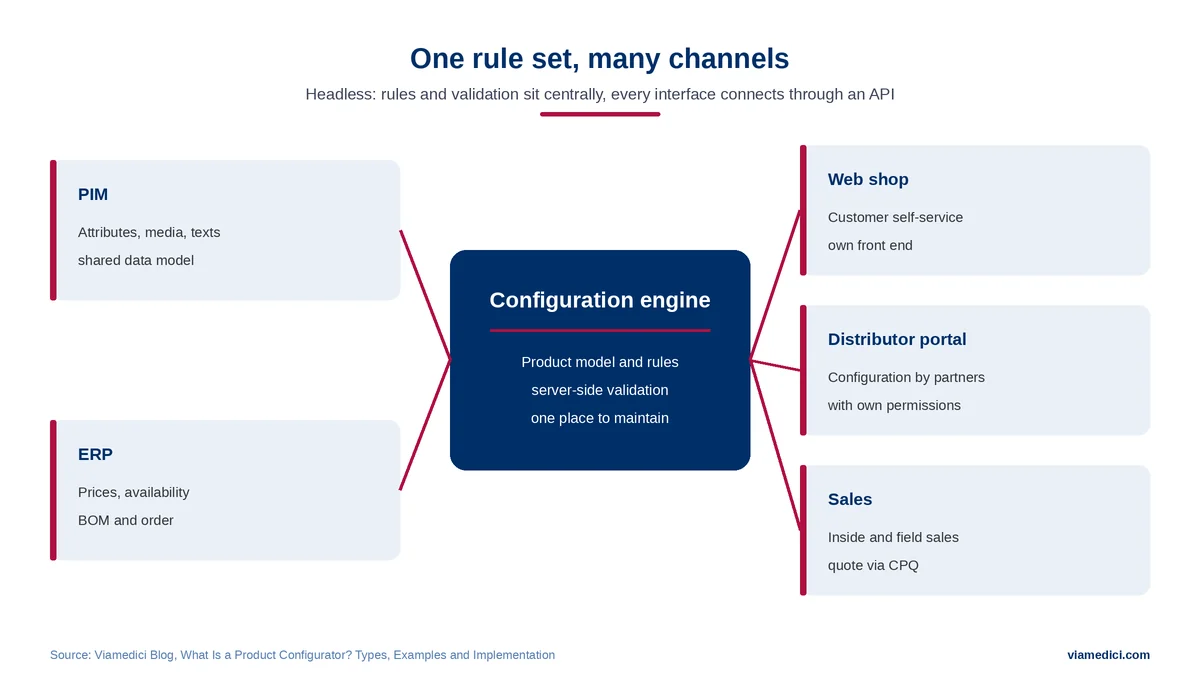
There is also the protection of know-how. Rule sets contain engineering knowledge that a manufacturer does not want to disclose. If the rules are evaluated on the server, the browser only sees the result.
Configurator, CPQ and guided selling
The terms overlap, but they mean different things. The configurator ensures a valid variant. CPQ adds pricing and quoting, meaning what follows commercially from the variant. Guided selling starts even earlier and uses questions about the application to determine which product family fits at all. In many projects all three work together, with the configurator in the middle.
How much does a product configurator cost?
There is hardly a list price, because costs depend on a few drivers. The license or subscription is often the smallest item. The largest share is often rule capture: experts from engineering and sales have to describe their knowledge in a way that can be modeled and tested. Then there is integration with ERP, PIM, CRM and online store, the front ends in headless projects and, finally, ongoing maintenance, because every new product line changes the rule set.
Common implementation mistakes
The most common mistake starts before the software: attributes are stored as free text in the ERP, and nobody has decided which values are allowed. Duplicate rule maintenance is just as costly: ERP variant configuration and the sales configurator are maintained separately and drift apart. Starting with a public self-service configurator before the rule set has been tested internally is risky too. And anyone who forces every special request into the rule set builds a model that nobody understands anymore. Without versioning, a configuration from five years ago can no longer be traced when a spare part is ordered. Responsibility for the model should therefore be clearly assigned, much like that of a data steward for product data.
What to look for in product configurator software
- Can business users maintain rules themselves without programming?
- Can rule sets be versioned and given validity dates?
- Are there test cases that run automatically after every rule change?
- Does the system explain conflicts in a way sales and customers understand?
- Does the configurator use the same data model as PIM and ERP?
- Can an old configuration be reproduced exactly later on?
The SPC Platform from Viamedici
With the SPC Platform (Smart Product Configuration), Viamedici provides the backend for product configurator software. It is based on rules and declarative models. Front ends show invalid combinations immediately, with an explanation and recommended alternatives, and input does not follow a rigid order. Existing rule sets from SAP variant configuration can be used and extended, and the front ends can be designed freely. The SPC Platform is available as a standalone product or as an extension of the EPIM/5 platform and the PIM system VIA/PIM360°.
Conclusion
A product configurator makes variant knowledge usable for sales and customers without every inquiry going through engineering. Whether that works depends less on the interface than on the product model and the rule set. Structuring the attributes first and testing the rule set internally before customers see it gives the configurator the best chance of still being right after the third product line.