
PIM and BIM meet where designers work with digital building models and need reliable manufacturer data to do so. Building Information Modeling (BIM) is the method of planning and operating a building as a digital model. The manufacturer’s PIM supplies the product information that flows into that model: dimensions, performance values, materials, classifications. Architects, building services engineers, estimators and distributors each need different formats. The data should still come from a single source.
What is BIM, and why does it matter to manufacturers?
BIM describes a way of working, not a software product. Everyone involved in a construction project works on a shared digital building model that is maintained across the entire lifecycle. The ISO 19650 series describes the principles of this information management. IFC (ISO 16739-1, last revised in 2024) has become the established open standard for exchange between applications.
The manufacturer comes into play as soon as a designer places a specific product in the model, such as a fire door or a radiator. That requires a BIM object with correct data. If the manufacturer does not provide one, the designer uses a generic object or a competitor’s product.
Geometry and information: what a BIM object contains
A BIM object has two parts. Geometry describes shape and dimensions; information covers everything else: performance values, material, fire rating, maintenance intervals, classification. The technical terms for these levels of detail are LOG and LOI.
Many manufacturers overestimate geometry. Designers usually need a lean model that represents the installation space correctly, not a photorealistic construction. For construction chemicals or insulation, geometry hardly matters at all. What counts is the information, and that is exactly what sits in the PIM. Geometry is usually created by a CAD team or a service provider, but the attributes should come from the PIM so that they match the catalog, the shop and the data sheet.
Clients define how much information a project requires in their exchange information requirements (EIR). The method is described in ISO 7817-1 as the level of information need, covering geometrical and alphanumerical information as well as documentation. For manufacturers, this means not every project needs every attribute, but the key values should be verified and documented. A BIM object with gaps in its core values is quickly replaced in the model by a generic one.
Who needs which format
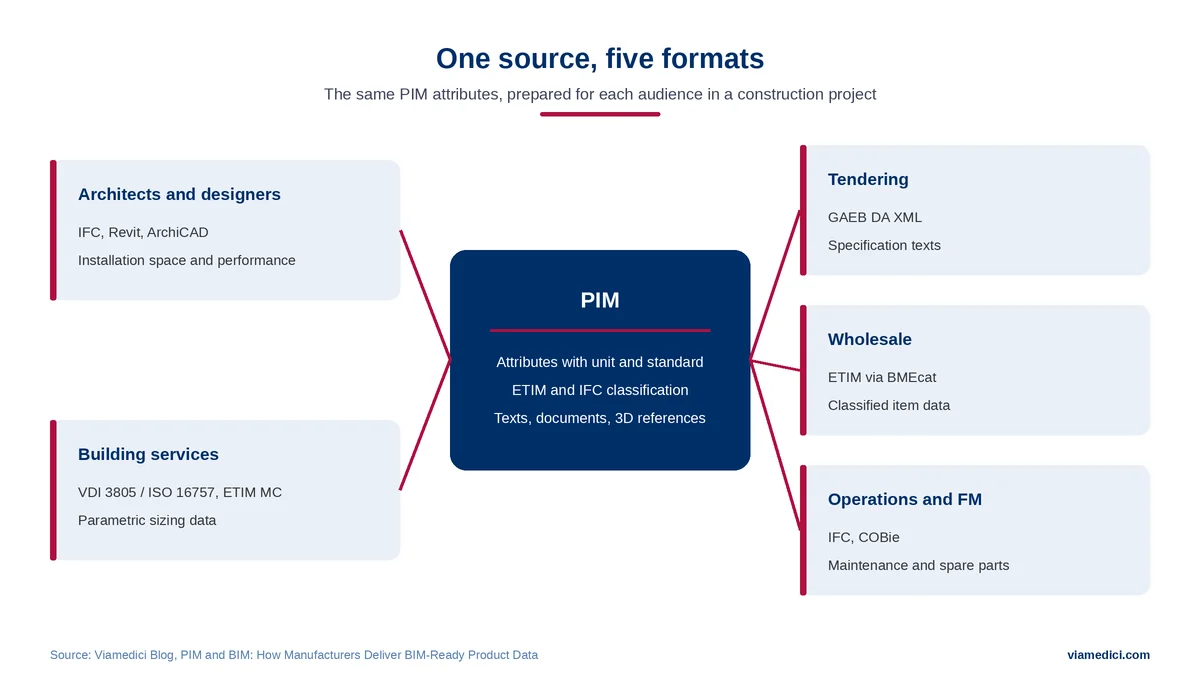
The same fire door appears in several places in a construction project, and each place expects a different format.
| Audience | Format | Typical content |
|---|---|---|
| Architects and designers | IFC, native Revit or ArchiCAD objects | Installation space, performance values, classification |
| Building services design | VDI 3805 or ISO 16757, ETIM MC | Parametric sizing data, connections |
| Tendering and estimating | GAEB DA XML | Specification texts, bill of quantities items |
| Wholesale | ETIM via BMEcat | Classified attributes, item and price data |
| Operations and facility management | IFC, COBie | Maintenance, warranty, spare parts |
For heating, air conditioning and plumbing, VDI 3805 governs product data exchange in the design process. The ETIM Modelling Classes standardize parametric content for BIM objects and, according to ETIM, combine well with IFC and bSDD. For manufacturers who already maintain their data with ETIM classification, this is the shortest route to BIM content.
IFC alone is not enough
IFC provides the schema and general property sets, but it does not define which manufacturer-specific attributes a product of a given class must have. Data templates cover that. ISO 23387, revised in 2025, describes such machine-readable templates, and ISO 23386 sets the rules for defining properties. The buildingSMART Data Dictionary (bSDD) provides property definitions centrally. Important for manufacturers: the bSDD contains definitions, not product data. The actual values remain the manufacturer’s job.
For the PIM, this means attributes should be maintained with unit, test standard and a reference to a recognized definition. A free-text “fire protection” field helps nobody. An attribute such as the fire resistance class under EN 13501-2, for example EI2 30, can by contrast be carried into the common formats.
Putting GAEB in context
GAEB is the German Joint Committee for Electronics in Construction, and the corresponding format is GAEB DA XML. It is used for data exchange in tendering, awarding and billing. The current version is 3.3, with version 3.4 available as a beta.
Manufacturers supply specification texts for it, that is, pre-written items that designers take into their bills of quantities. These texts also belong in the PIM, because they are based on the same attributes as the BIM object. Public contracts in Germany are generally tendered on a product-neutral basis (Section 7(2) VOB/A, Section 31(6) VgV). A reference product is only allowed as an exception and with the addition “or equivalent”. A well-written manufacturer text therefore describes the performance rather than relying on the brand name.
The workflow: from ERP item to BIM object
Item master data comes from the ERP. In the PIM, it is enriched with technical attributes, descriptions and classifications, for example according to ETIM and with a reference to the IFC class. Geometry and 3D files sit in digital asset management or with the CAD service provider. The BIM object is created from both, either through an object generator or a BIM platform that takes the data from the PIM. In parallel, the PIM supplies the attributes for the GAEB texts and generates the ETIM delivery to wholesale.
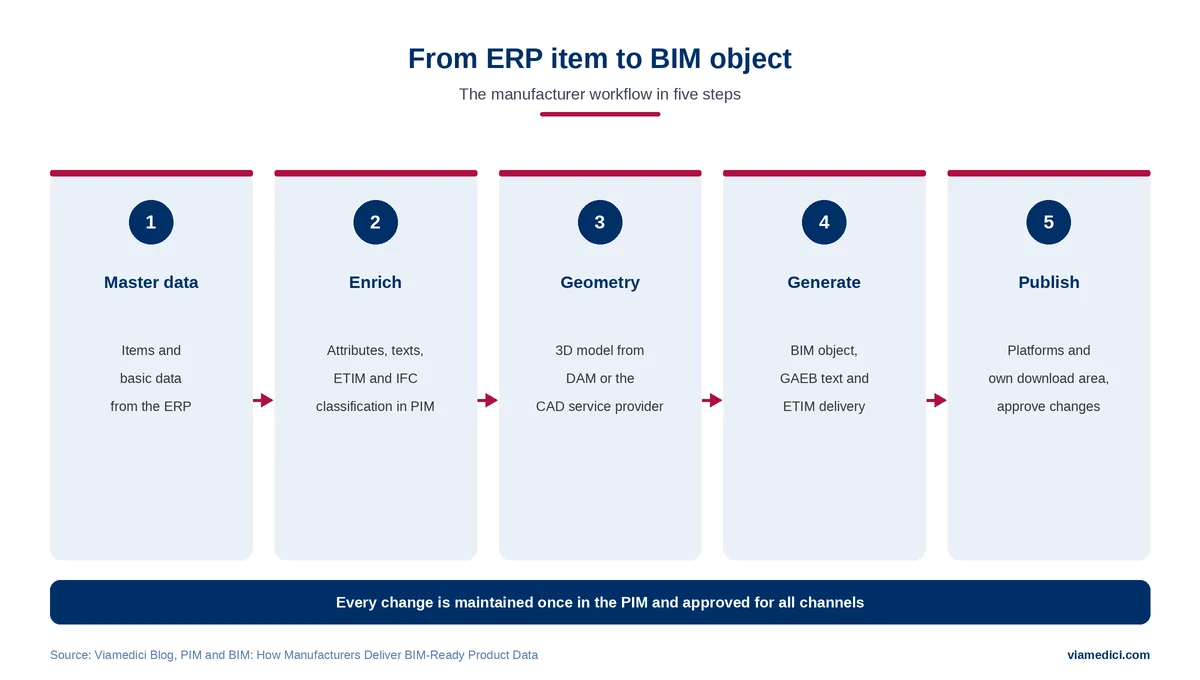
The benefit shows when things change. If a material thickness changes or a fire rating is recertified, the value is changed once in the PIM. How quickly the change reaches every channel depends on how far publication to platforms and the manufacturer’s own download area is automated. Without this chain, contradictory values appear: the old rating in the BIM object, the new one in the specification text.
Where BIM objects are published
Designers look for BIM objects in several places. International platforms such as BIMobject or bimstore bundle content from many manufacturers and are integrated directly into common CAD applications. For products with ETIM classification, ETIM Germany also offers its own BIM services. Many manufacturers also offer the objects in their own download area, often together with specification texts and data sheets.
Each of these channels has its own format and metadata requirements. If content is maintained by hand on each platform, versions drift apart quickly. It makes more sense to feed all channels from the PIM and define for each platform which attributes and files it receives.
Example: a fire door manufacturer
Take a manufacturer that offers fire doors in several fire resistance classes, sizes and finishes. Architects want the door as an IFC object in the model, estimators a GAEB specification text, wholesalers ETIM-classified item data. In a scenario like this, each department often maintains its own version, and after a recertification the old rating stays in the BIM object for weeks.
With the PIM as the shared source, the technical values are maintained in one place. All outputs are generated from it, and a change is approved for every channel at the same time.
Differences between industries
A PIM for the construction industry has to cover very different product ranges. Building services manufacturers need parametric sizing data, such as performance curves and connection dimensions under VDI 3805. Building materials and construction chemicals manufacturers supply little geometry but many building physics values. Manufacturers of windows, doors or facade elements deal with many variants. There, a static BIM object quickly reaches its limits, and the variant rules belong in a product configurator, with pricing and quotes handled through CPQ connected to the PIM.
Is BIM mandatory in Germany?
Not directly for manufacturers. The master plans bind the federal construction administration, and designers are reached through the EIR in their contracts. For federal highways, BIM is planned as the standard process from 2026, according to the Federal Ministry of Transport. For federal buildings, the [BIM master plan] published in 2021(https://www.buildingsmart.de/buildingsmart/aktuelles/neuer-masterplan-fuer-den-bundeshochbau-veroeffentlicht) provides for a phased introduction by 2027, using open formats such as IFC. Manufacturers are still affected indirectly: anyone who wants to be specified in such projects needs usable BIM data.
The same data for product passport and declaration of performance
The structured attributes a BIM object needs are largely the same ones that appear in the declaration of performance, the environmental product declaration and, in future, the Digital Product Passport. The new Construction Products Regulation (EU) 2024/3110 also provides for a Digital Product Passport for construction products, with details to follow through delegated acts. Well-maintained attributes in the PIM therefore serve several obligations at once.
Limits and effort
A PIM does not create geometry, and publishing to BIM platforms needs its own connectors. Creating BIM objects takes considerable effort, and whether it pays off depends on the product range and demand. It makes sense to start with the products designers request or download most often and to define the data templates there first. Platform download figures and questions from sales quickly show where demand lies. Modeling an entire range at once is rarely economical.
Checklist: BIM-ready product data
- Attributes with unit, test standard and reference to a recognized definition
- Classification according to ETIM and assignment to the IFC class
- Geometry at the level of detail designers actually need
- Specification texts generated from the same attributes
- Versioning and approval in the PIM before data is published
The VIA/PIM360° product page shows how a PIM system manages this data centrally and delivers it to the different channels. Industry-specific requirements are described on the construction and building services page.
Conclusion
PIM and BIM solve different but closely related tasks. BIM needs reliable manufacturer information, and the PIM supplies it. Attributes maintained in line with standards are the basis for BIM objects, specification texts, trade data and, in future, the product passport. The effort lies less in the technology than in a clean data model.