Workflow | Portals (Supplier Portal, Media Portal, Sales Portal | AI (product expert/co-pilot/auto-translation) | Digital Shelf |
Media Management | Sustainability(DPP & EPD) | SAP
Workflow | Portals (Supplier Portal, Media Portal, Sales Portal | AI (product expert/co-pilot/auto-translation) | Digital Shelf |
Media Management | Sustainability(DPP & EPD) | SAP
Governance programmes rarely fail on strategy. They fail because nobody actually enforces the policies day to day. That is exactly the gap the Data Steward fills, and precisely because the role sits between the business, IT and management, many org charts either leave it unnamed or confuse it with the Data Owner. That is not a semantic detail, it is the reason governance programmes look good on paper and still do not work in practice.
What Is a Data Steward?
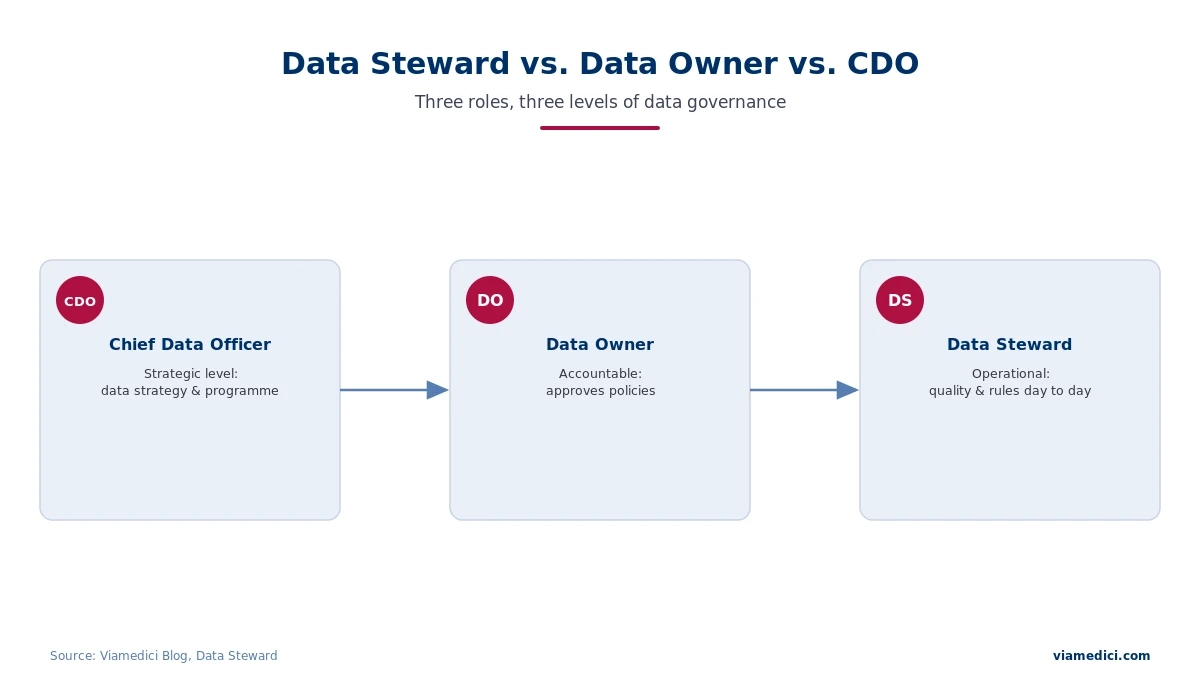
A Data Steward is the person responsible day to day for the quality and usability of a specific data domain, usually products, customers or suppliers. Within Data Governance, the steward defines metrics, enforces rules and keeps definitions and metadata current. Unlike the Data Owner, who is accountable and approves policies, the steward works hands-on with the data itself, not just with decisions about it, making the role the exact point where governance either becomes lived practice or stays on paper.
The 2026 Evolution: Business Steward and AI Steward
A trend that does not appear in older role descriptions but is gaining substance in 2026: the classic Data Steward role is increasingly splitting into two variants. The Business Steward keeps the traditional job of maintaining quality and metadata for a business domain. Alongside it, the AI Steward, sometimes called Model Steward, is emerging, maintaining model cards, documenting training data provenance, monitoring bias risk and ensuring EU AI Act conformity. For companies using AI-assisted attribute suggestions or classification in PIM, this is not an academic distinction. Whoever owns the quality of AI training data is increasingly a different person from whoever guards classic product data quality.
Day-to-Day Responsibilities
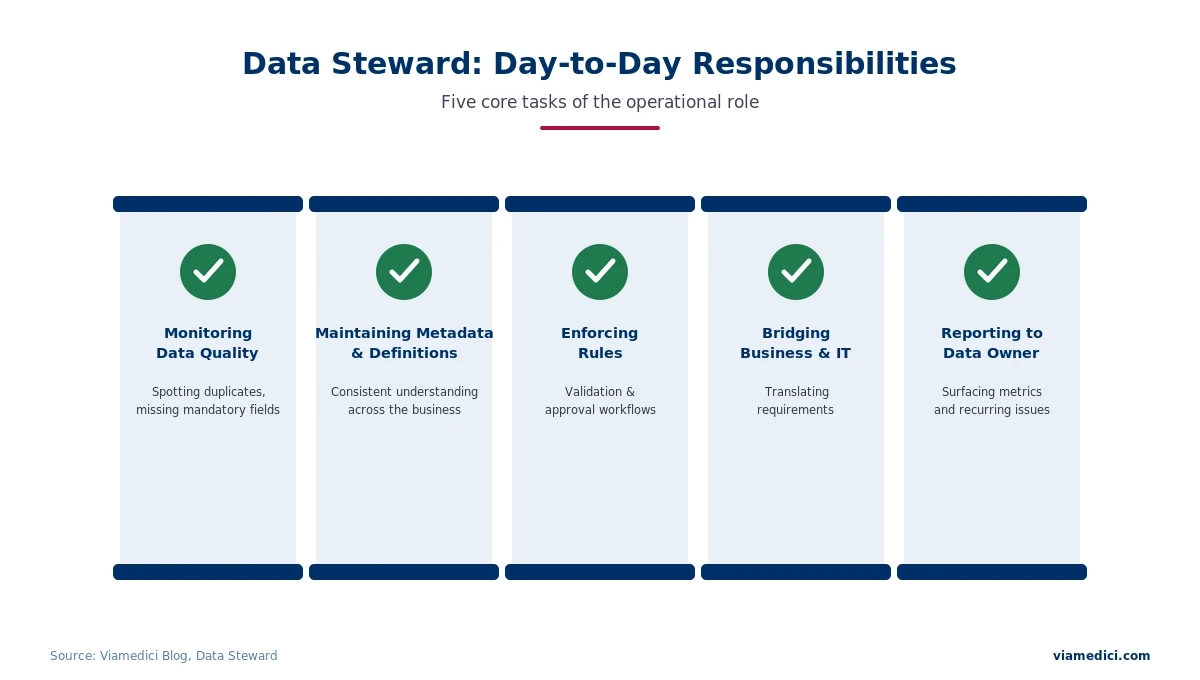
Monitoring data quality: spotting duplicates, missing mandatory fields and inconsistent values before they flow into downstream systems.
Maintaining metadata and definitions: making sure terms like ‘active product’ or ‘valid customer’ are understood consistently across the business.
Enforcing rules: applying validation rules, mandatory attributes and approval workflows in practice, not just documenting them.
Bridging business and IT: translating business requirements into technically implementable rules and back.
Reporting to the Data Owner: surfacing quality metrics and recurring issues so the owner can make informed decisions.
Most of this runs on approval workflows in PIM rather than on manual checks.
In the product domain, one responsibility rarely shows up in generic role descriptions: the ongoing upkeep of attribute models in the PIM. A Data Steward for product data does not decide on new mandatory fields, but is usually the first to notice when an existing attribute model no longer fits product reality, for instance when a new product line has technical characteristics the current schema cannot capture.
Skills That Matter
A good Data Steward needs deep subject-matter knowledge of their domain, a real understanding of what a product or customer record means operationally. On top of that comes analytical craft: reading data quality metrics, spotting patterns in faulty data, and working with tools such as data catalogs or a PIM. Communication matters just as much, since the role constantly mediates between business, IT and management. Governance literacy rounds out the profile. A steward does not need to write policy, but must understand it and apply it consistently day to day. Anyone taking on AI Steward duties going forward also needs a working understanding of how training data shapes model behaviour, not at data scientist depth, but deep enough to spot bias risk before it becomes a problem.
Blur this distinction and you either hand operational responsibility to someone without decision authority, or overload decision-makers with detail work. In practice, the most common mistake is loading Steward duties onto the Data Owner because they are already the most domain-knowledgeable person around. That works short term, but overloads the executive and leaves the actual owner job, making strategic decisions, undone.
How Do You Become a Data Steward?
There is no single career path, but an established reference for formal qualification is the DAMA CDMP certification (Certified Data Management Professional). Depending on the module, it requires between 900 and 1,400 hours of practical experience in data governance or stewardship before the exam counts. In practice, though, most Data Stewards grow out of an existing business role, such as product management, category management or quality assurance, precisely because the required domain knowledge already lives there.
How PIM and MDM Support Data Stewards
A master data management system gives Data Stewards the technical foundation to maintain Golden Records, detect duplicates and keep changes traceable, instead of monitoring quality manually in spreadsheets. For the product domain specifically, a PIM takes over this role: mandatory fields, validation rules and approval workflows run automatically, while the steward handles the exceptions and edge cases no system can resolve alone. When the data comes from suppliers, a PIM supplier portal applies the same validation rules at upload. A VIA/PIM360° setup with clear attribute models and approval processes cuts exactly the kind of detail work that otherwise ties a steward down, freeing time for more strategic tasks such as model upkeep and quality analysis.
Common Pitfalls When Staffing the Role
The first pitfall is never officially naming the role. When stewardship tasks get done informally by whoever has time, accountability is the first thing to disappear under deadline pressure. The second pitfall is scoping the domain too broadly: a steward responsible for products, customers and suppliers at once inevitably loses depth in each individual domain. The third pitfall is a lack of backing from the Data Owner. Without clear escalation paths, the steward is left without decision power in cross-functional conflicts, and effectively powerless. Where that work shows up in numbers is data quality in the enterprise.
Not necessarily as a full-time role. Smaller companies often fold the responsibility into an existing role, such as product management or marketing, as long as accountability is clearly named.
An increasingly distinct 2026 role variant that maintains model cards, documents training data provenance and monitors bias risk. It complements the classic Business Steward wherever AI-assisted data processes are in use.
Not necessarily. A formal qualification such as the DAMA CDMP certification helps but is not mandatory. In practice, domain knowledge often counts for more than the certificate itself.
We use cookies and similar technologies to ensure the functionality of our website and to improve content. We use cookies and similar technologies to ensure the functionality of our website and to improve content. For the latter, pseudonymised data from visitors is collected, e.g. analysed for purposes of statistics passed on to partners for remarketing. By clicking “Accept all”, you consent to the storage and reading of information on your end device and to the further processing of personal data (e.g. your IP address) and potentially its transmission to services, including in third countries. By selecting “Strictly necessary for technical purposes”, you refuse the use of services that require consent. You will find details under “Customise”, and the option to consent to individual categories.. You can revoke consent you have given at any time via “Privacy settings” in the Privacy policy.
Please select your language before accepting cookies :
Mandatory
Always active
These cookies are needed for a smooth operation of our website.
External
Content from video and social media platforms is blocked by default. Consent to external media here to view all external media without further manual approval.
Statistics
The technical storage or access that is used exclusively for statistical purposes.The technical storage or access that is used exclusively for anonymous statistical purposes. Without a subpoena, voluntary compliance on the part of your Internet Service Provider, or additional records from a third party, information stored or retrieved for this purpose alone cannot usually be used to identify you.
Marketing
The technical storage or access is required to create user profiles to send advertising, or to track the user on a website or across several websites for similar marketing purposes.




 In the product domain, one responsibility rarely shows up in generic role descriptions: the ongoing upkeep of attribute models in the PIM. A Data Steward for product data does not decide on new mandatory fields, but is usually the first to notice when an existing attribute model no longer fits product reality, for instance when a new product line has technical characteristics the current schema cannot capture.
 In the product domain, one responsibility rarely shows up in generic role descriptions: the ongoing upkeep of attribute models in the PIM. A Data Steward for product data does not decide on new mandatory fields, but is usually the first to notice when an existing attribute model no longer fits product reality, for instance when a new product line has technical characteristics the current schema cannot capture.