Workflow | Portals (Supplier Portal, Media Portal, Sales Portal | AI (product expert/co-pilot/auto-translation) | Digital Shelf |
Media Management | Sustainability(DPP & EPD) | SAP
Workflow | Portals (Supplier Portal, Media Portal, Sales Portal | AI (product expert/co-pilot/auto-translation) | Digital Shelf |
Media Management | Sustainability(DPP & EPD) | SAP
What Is Data Governance? Strategy, Roles and Tools for Enterprises
Share This Post
Table of Contents
Data governance is the framework of policies, roles, standards and decision rights that determines how an organisation collects, defines, secures and uses its data. For B2B manufacturers and distributors it decides something very concrete. Either the data flowing into every channel can be trusted, or errors and duplicates quietly eat into margin while compliance gaps build up in the background. This guide walks through what data governance actually is, how it differs from data management and MDM, which roles and tools it involves, and how to build a programme that holds up.
What Is Data Governance?
Data governance is the discipline that puts accountability around data as a business asset. It sets out who may do what with which data, in which situations, and by which methods. The aim is practical rather than abstract: keep enterprise data available, usable, consistent, secure and compliant, and turn ownership into a habit instead of an afterthought.
In practice it answers the questions every data-driven company keeps running into. Who owns the product master record? What does “customer” officially mean? Which fields are mandatory before a product can go live, and who signs off a price change? When there are no agreed answers, each team quietly invents its own, and the data drifts apart.
Data Governance vs. Data Management vs. MDM
These three terms get mixed up constantly, so it helps to pull them apart. Data management is the broad umbrella, the full set of disciplines that turn raw data into something usable, from architecture and storage through to security, integration and quality. Data governance sits at the centre of that wheel and sets the rules the other disciplines follow. Master data management, or MDM, is narrower again. It is the operational engine that produces a single, consistent “golden record” for the data a business cannot afford to get wrong, typically customer, product and supplier.
The short version: governance sets the rules, MDM does the work. Governance covers all data and defines the standards. MDM puts those standards into practice for the core master-data domains.
Why Data Governance Matters for Enterprises
Poor data quality is not a cosmetic issue. It shows up on the balance sheet. Gartner has put the average cost of poor data quality at 12.9 million US dollars per organisation each year. MIT Sloan Management Review estimates that most companies forfeit the equivalent of 15–25 % of revenue to it. A widely cited IBM figure from 2016, popularised by Harvard Business Review, placed the cost to the US economy at roughly 3.1 trillion dollars a year. These are estimates, and worth treating as such, but the direction of travel is not in doubt.
For a manufacturer or distributor the consequences are tangible. A wrong technical attribute triggers a wrong order. An outdated price erodes margin without anyone noticing. An incomplete product record fails to convert in the shop, or gets rejected outright by a marketplace. Governance lowers these risks because it makes quality, ownership and compliance explicit and repeatable rather than accidental.
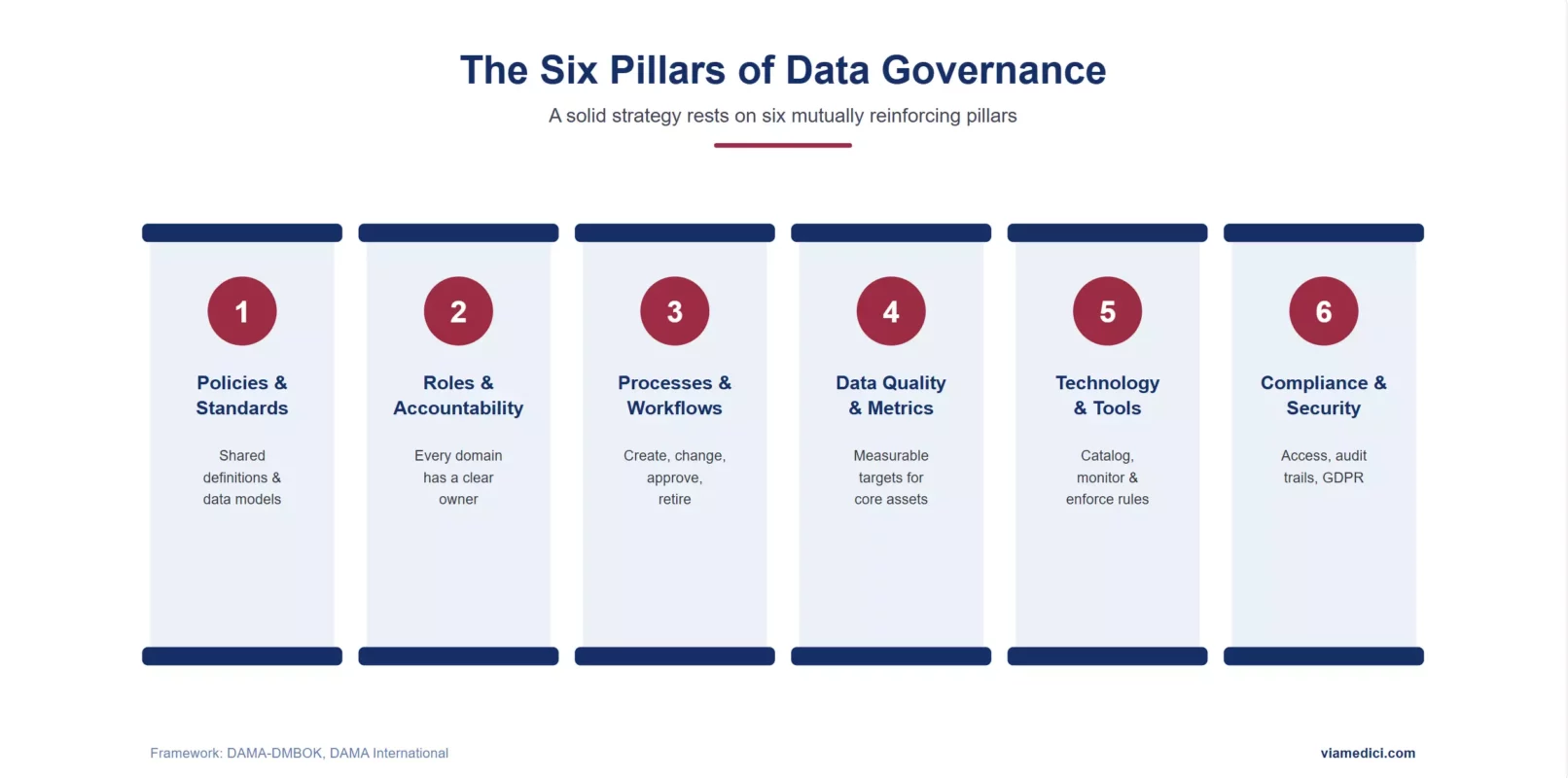
The Six Pillars of a Data Governance Strategy
A workable strategy rests on six pillars that lean on each other, and the missing one is usually where a programme stalls. The first is a clear set of policies and standards: shared definitions, naming conventions and data models that let systems speak the same language. The second is roles and accountability, so that every critical data domain has a name attached to it. Processes and workflows come third, covering how data is created, approved, changed and eventually retired. The fourth pillar is data quality together with the metrics that track it, with measurable targets for the assets that matter most. Technology and tools form the fifth, meaning the platforms that catalogue, monitor and enforce the rules at scale. Compliance and security round things off, from access controls and audit trails to alignment with the GDPR.
If you want an established reference for all of this, most teams reach for the DAMA-DMBOK (Data Management Body of Knowledge) from DAMA International. It maps data management into eleven connected knowledge areas and places data governance at the hub, with architecture, modelling, storage, security, integration, content management, reference and master data, warehousing and BI, metadata and quality arranged around it.
Roles and Responsibilities in Data Governance
Governance only works when responsibility is unambiguous, and a handful of roles recur in almost every mature programme. At the top sits the Chief Data Officer, who owns the enterprise-wide data strategy and the governance programme itself. Below that, each domain has a Data Owner, a senior business leader who is accountable for it, approves the policies and decides on use, access and protection. Owners stay accountable rather than hands-on. The day-to-day work falls to Data Stewards, the business-facing people who guard quality and fitness for purpose, define the metrics, enforce the rules and keep definitions and metadata current. Their role in detail is explained in Data Steward responsibilities and skills. The technical side belongs to the Data Custodian, who implements and runs the controls for storage, security and access. Holding it all together is the Data Governance Council, a cross-functional group drawn from IT, finance, operations and marketing that approves policies, watches quality and keeps compliance on track.
Data Governance Tools and Technology
Modern governance platforms tend to share the same core. They catalogue metadata, trace data lineage so you can see where a value came from and how it changed, monitor quality, and enforce policies and access rights, increasingly with a layer of AI-assisted discovery on top. The names you meet most often are Collibra, Microsoft Purview, Informatica, Alation, Atlan and Ataccama. Which one fits depends entirely on context. Collibra and Informatica suit large, regulated enterprises. Microsoft Purview is the natural choice inside a Microsoft estate. Atlan and Alation lead on usability and discovery, while Ataccama has a reputation built on data quality. One caveat is worth stating plainly: a tool enforces governance, it does not create it. The policies, roles and standards have to exist first.
Data Governance and Product Data: The Role of PIM
Product information is one of the most valuable master-data domains a manufacturer or distributor holds, and one of the hardest to keep consistent across channels. It is also where governance meets the PIM. Governance provides the rulebook, meaning the standards, the roles and the quality metrics. The PIM is the platform that enforces those rules on product data, day in and day out.
In a well-run PIM, mandatory fields, lists of values, taxonomy rules and validation constraints apply automatically, and every change stays traceable through stewardship roles and audit trails. As catalogues grow across regions and channels, that discipline is what keeps product information quality high and time-to-market short. Product data, put simply, is a master-data domain governed by the same logic as MDM.
The Regulatory Backdrop: GDPR, EU Data Act and AI Act
European regulation is a big part of why data governance has moved up the agenda. The GDPR remains the baseline for anything involving personal data. The EU Data Governance Act, in force since 2022 and applicable since September 2023, encourages trustworthy data sharing and the common European data spaces. The EU Data Act, applicable since 12 September 2025, governs access to data from connected products and the right to switch cloud providers, with further obligations arriving in 2026 and 2027. What that means for keeping control of your own data is covered in data sovereignty in practice. The EU AI Act came into force in August 2024, becomes fully applicable in August 2026, and names data governance explicitly as a requirement for high-risk AI. The pragmatic move is to handle all of this as one joined-up compliance effort rather than four separate projects. Two cases show what that means on the ground: the EU packaging regulation PPWR and the Digital Product Passport.
How to Build Data Governance in Six Steps
If you are starting from scratch, the sequence below keeps the effort focused. It is the one place in this guide where a numbered list genuinely earns its keep.
Secure executive sponsorship and define clear business objectives for the programme.
Assign the roles: name owners, stewards and a governance council for your critical data domains.
Define policies and standards, from shared definitions and mandatory fields to naming and quality rules.
Choose the enabling technology, such as a catalogue, quality monitoring and, for product data, a PIM.
Measure and report with quality KPIs and dashboards for the assets that matter most.
Iterate: review the metrics regularly, close the gaps and widen the scope domain by domain.
Data management is the broad set of disciplines that make data usable. Data governance is the function within it that sets the rules, roles and standards the other disciplines follow.
Accountability sits with business data owners and, at programme level, a Chief Data Officer. Day-to-day quality is handled by data stewards, technical controls by data custodians, and oversight by a governance council.
No. Policies, roles and standards come first. Tools such as data catalogues, quality platforms or a PIM enforce governance at scale once the framework is in place.
A PIM operationalises governance for product data. It enforces mandatory fields, validation rules and approval workflows, which keeps product information consistent and audit-ready across channels.
Done well, governance turns data from a liability into something the business can rely on. The starting point is rarely a tool. It is clear ownership and agreed standards, enforced by the right technology, a PIM in the case of product data, and measured often enough to catch problems while they are still small.
We use cookies and similar technologies to ensure the functionality of our website and to improve content. We use cookies and similar technologies to ensure the functionality of our website and to improve content. For the latter, pseudonymised data from visitors is collected, e.g. analysed for purposes of statistics passed on to partners for remarketing. By clicking “Accept all”, you consent to the storage and reading of information on your end device and to the further processing of personal data (e.g. your IP address) and potentially its transmission to services, including in third countries. By selecting “Strictly necessary for technical purposes”, you refuse the use of services that require consent. You will find details under “Customise”, and the option to consent to individual categories.. You can revoke consent you have given at any time via “Privacy settings” in the Privacy policy.
Please select your language before accepting cookies :
Mandatory
Always active
These cookies are needed for a smooth operation of our website.
External
Content from video and social media platforms is blocked by default. Consent to external media here to view all external media without further manual approval.
Statistics
The technical storage or access that is used exclusively for statistical purposes.The technical storage or access that is used exclusively for anonymous statistical purposes. Without a subpoena, voluntary compliance on the part of your Internet Service Provider, or additional records from a third party, information stored or retrieved for this purpose alone cannot usually be used to identify you.
Marketing
The technical storage or access is required to create user profiles to send advertising, or to track the user on a website or across several websites for similar marketing purposes.