A golden record is the single, trusted version of a business record that an entire organisation can rely on. When the same customer, product or supplier exists in five systems with five slightly different spellings, addresses or specifications, the golden record is the one reconciled version treated as authoritative. It is a core concept in master data management (MDM), and it is what separates a genuine single source of truth from a pile of conflicting copies. This article explains what a golden record is, how it differs from a single source of truth, how one is actually built through matching and survivorship rules, and why it matters for product and customer data.



What Is a Golden Record?
A golden record is an explicitly governed, traceable version of a data entity, created by reconciling records from every system that holds information about it. The point is not simply to store data in one place. It is to resolve the contradictions between sources, so that when your ERP says a customer sits at one address and your CRM says another, there is a defined, defensible answer to which one is correct. That answer is produced by matching logic, survivorship rules and stewardship, all governed rather than left to chance. Without them you have a data lake, not a golden record.Golden Record vs. Single Source of Truth
The two terms get used interchangeably, but they are not the same thing. A single source of truth is the architectural goal: one place the whole business trusts for a given kind of data. The golden record is the unit that makes that goal real, the individual reconciled record for one product or one customer. Put plainly, the single source of truth is the destination; golden records are what fill it. A system can promise a single source of truth, but it only delivers one if it can actually produce a correct golden record for each entity.How a Golden Record Is Created
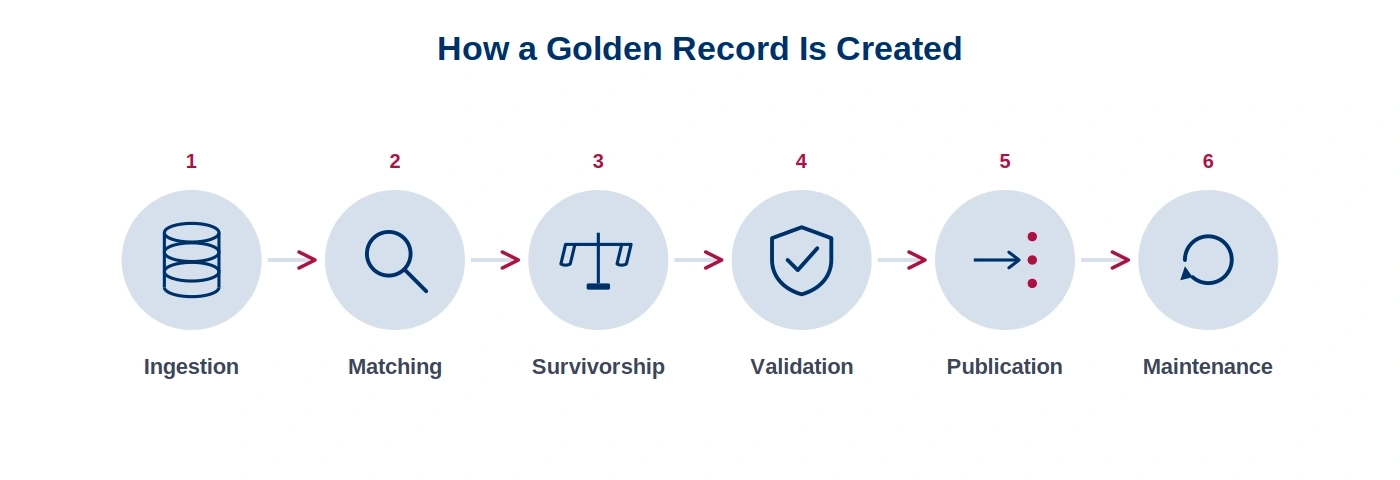
Building a golden record is a defined process, not a one-time merge. It runs in six stages:- Ingestion: connect the source systems (ERP, CRM, PIM, e-commerce, supplier feeds) and load their records into a staging area in a consistent format. Supplier product data ideally arrives already structured through a PIM supplier portal.
- Matching: identify which records across those systems actually describe the same real-world entity, even when identifiers and spellings differ.
- Survivorship: apply rules that decide, attribute by attribute, which value wins when sources disagree.
- Validation: check the resulting record against business and format rules before it is trusted.
- Publication: distribute the golden record back to the connected systems so they all work from it.
- Maintenance: keep it current as sources change, because a golden record decays like any other data if it is left alone.
Survivorship Rules Explained
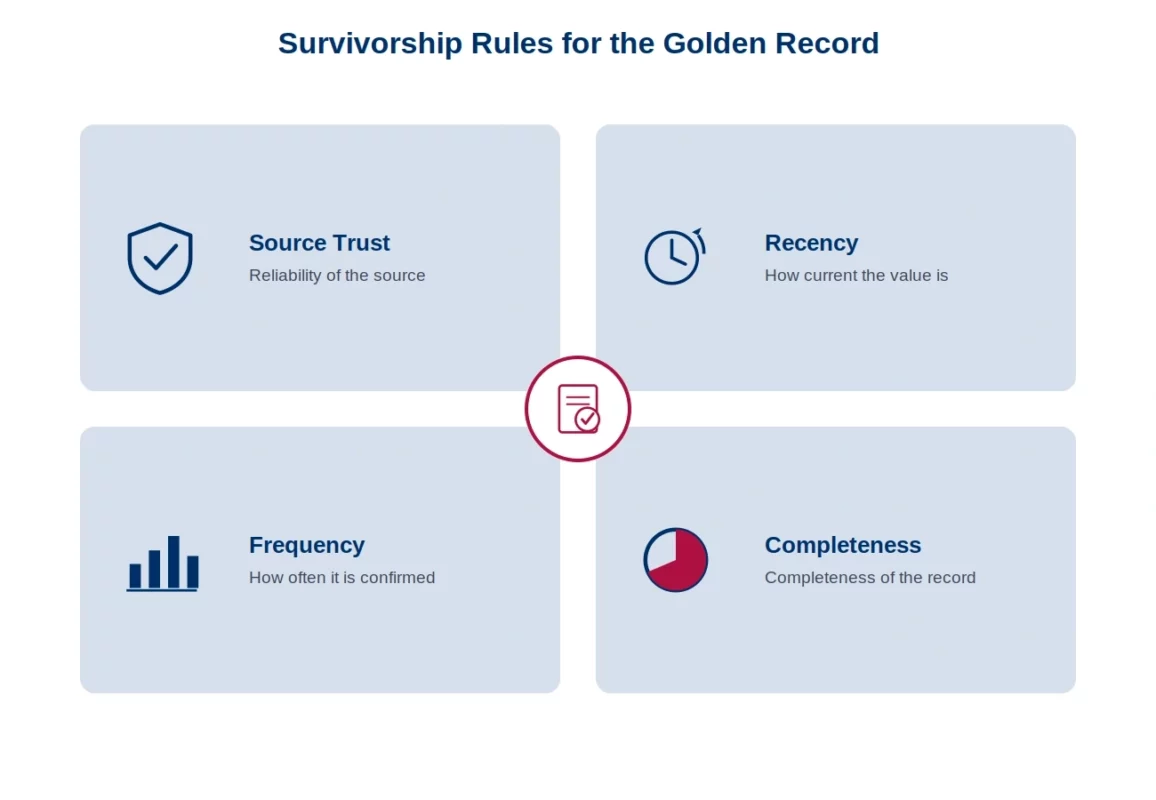
Survivorship is the heart of the golden record and the part most people underestimate. It is the logic that decides which value survives when two systems disagree. Four approaches dominate. Source trust prioritises the value from whichever system is designated most reliable for that attribute, so financial data might win from the ERP while marketing copy wins from the PIM. Recency takes the most recently updated value, which suits fields like contact details. Frequency keeps the value that appears most consistently across sources. Completeness favours the record with the most fully populated fields. Real implementations mix these per attribute, and the rules themselves are set through data governance rather than by whoever happens to run the import. That governance is what makes a golden record defensible rather than arbitrary. Who maintains these rules in practice is covered in Data Steward responsibilities and skills.