B2B buying is changing at the root. For years the goal was to give people better interfaces: portals, shops, self-service. Agentic commerce inverts that logic. Instead of a person clicking through a shop, an AI agent takes over the task: it researches options, compares offers, negotiates within defined rules and places the order. For B2B companies with recurring orders, complex procurement and lean purchasing teams, this is not a gimmick but a lever for efficiency. This article explains what agentic commerce is, why it matters for B2B, the concrete benefits, and why in the end everything depends on one thing: clean, structured product data.

What Is Agentic Commerce?
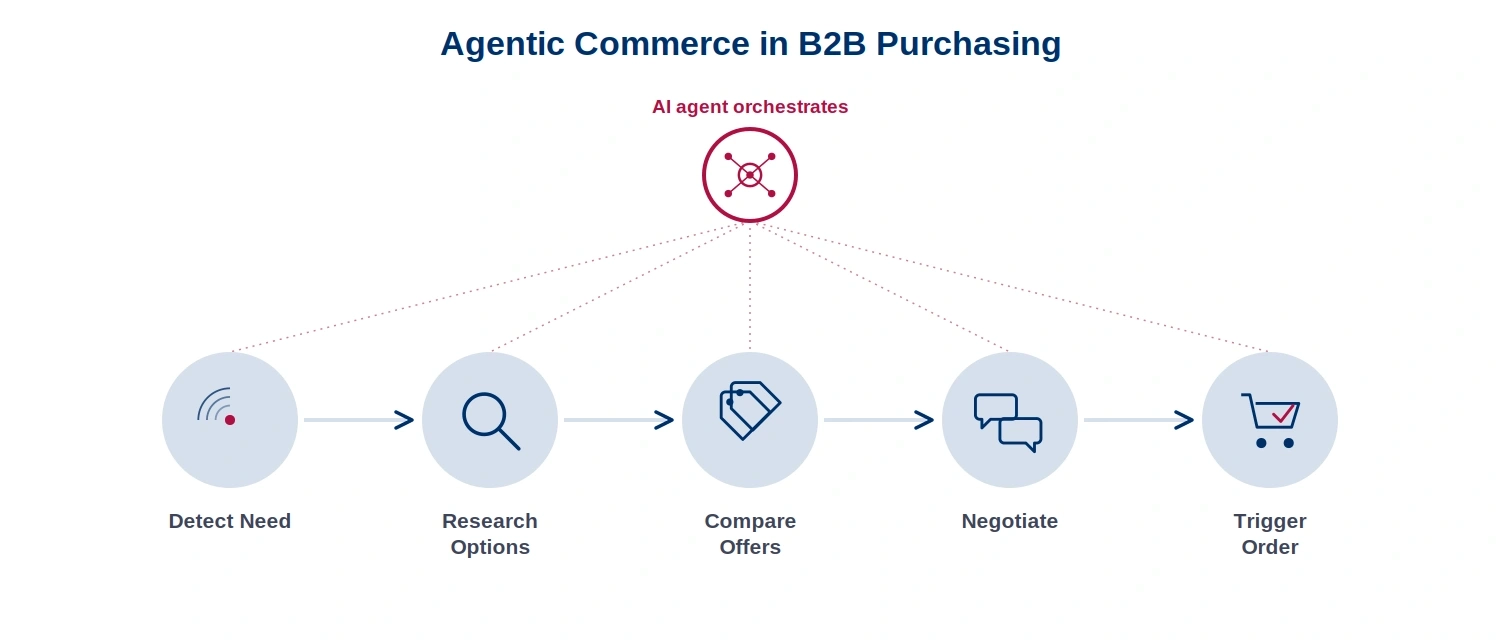
Agentic commerce is the use of autonomous AI agents that carry out buying processes on behalf of a business: interpreting needs, researching options, comparing offers, negotiating and completing transactions. The difference from classic e-commerce is who acts. In the classic model a person navigates the interface and the shop reacts. In agentic commerce the software is the actor and works through a multi-step procurement process without a human clicking between steps. The human-facing counterpart is guided buying in B2B.
The distinction from a chatbot matters. A chatbot answers questions and hands off. An agent pursues a goal and takes actions across systems until the goal is met. The outcome is not the conversation; it is the completed order. Technically this works because agents talk to catalogues, ERP and procurement systems directly through interfaces and machine-readable product data, rather than depending on a screen built for humans.
Why Agentic Commerce Matters for B2B
B2B is where agentic commerce meets ideal conditions, because the processes are structured, recurring and rule-based. Complex procurement with many line items, approval stages and supplier criteria can be expressed as rules an agent executes reliably. Recurring orders and replenishment are the most obvious case: an agent watches stock levels, spots demand, picks the right supplier and reorders before anything runs out. Multi-stakeholder decisions, the norm in B2B rather than the exception, get faster when an agent prepares and standardises offers and brings only the decision forward for approval.
A concrete example makes it tangible. A maintenance operation constantly consumes C-parts such as seals, filters and screws. An agent knows the minimum stock levels, checks prices and lead times overnight across three listed suppliers, selects within the configured budget and compliance rules, and raises the order. In the morning the buyer sees a justified decision to approve instead of five open tabs. Narrow, rule-based cases like this are the realistic entry point, not fully autonomous large-scale sourcing.
The market is already moving. Forrester expects that by the end of 2026 roughly one-third of B2B payment workflows will involve AI agents, and analysts anticipate a growing share of vendors taking part in AI-assisted quote negotiations, sometimes as direct agent-to-agent negotiation where buyer and seller systems settle terms within predefined rules and speed the transaction up.
Concrete Benefits for B2B Companies
The value lands where time and margin are lost in the process today. Much of it depends on generating quotes automatically.
Purchasing efficiency: routine procurement runs without manual click paths, so the team focuses on negotiation and strategy instead of order handling.
24/7 autonomous offer comparison: agents check prices, availability and terms across suppliers around the clock, not only in office hours.
Lower process costs: fewer manual steps per order noticeably reduce cost per transaction, especially at high order volumes and many small orders.
Personalization at scale: an agent can apply customer-specific catalogues, prices and terms in real time, delivering personalization that does not scale by hand.
The common thread is a shift of human time away from routine and toward judgement. Manual order handling eats a large part of the purchasing day with no value beyond the transaction itself. When an agent takes the repetitive steps, capacity and attention move to the cases where human judgement counts: strategic suppliers, exceptions, negotiations with real room to move. The same holds in mirror image on the sell side, because a vendor whose product data is agent-readable is the one that buying agents can find and compare correctly in the first place.
The Prerequisite: Structured Product Data and PIM as the Foundation
Agentic commerce is only as good as the data the agent reaches. A person can interpret a patchy product description and still choose correctly. An agent cannot. It needs structured, complete, machine-readable product data: unambiguous attributes, clean classifications, correct prices and availability. That is exactly what a PIM provides, maintaining product data centrally, validating it and serving it to every channel. Without that foundation an agent compares apples with oranges and makes wrong decisions with full autonomy.
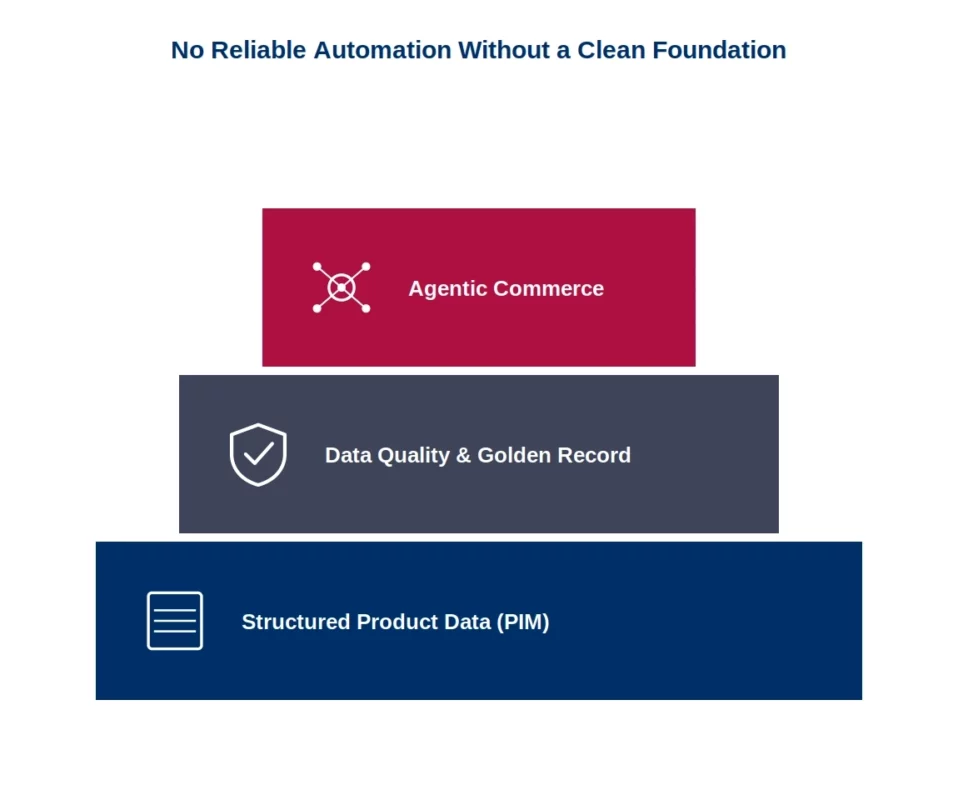
A simple comparison shows how decisive this is. To assess two seals, an agent has to line up material, pressure rating, standard and unit of measure unambiguously. If one is in inches and the other in millimetres, one is missing its pressure rating and the other carries a different classification, a clean comparison is impossible and the agent decides on the wrong basis. Consistent attributes, aligned classifications and, where relevant, standardised data down to the digital product passport are therefore not optional; they are the condition for automation to become reliable at all.
The bar rises because an agent has no tolerance for contradiction. Two different descriptions of the same article are an annoyance to a person and an error to an agent. That is why data quality and a reliable golden record per product are the real ticket into agentic commerce. Companies that can consolidate and maintain their master data are prepared; those that cannot are punished by autonomous processes rather than rewarded.
Challenges and Risks
Autonomy without control is not efficiency but risk. Three points deserve attention. Trust: an agent that orders on its own needs clear limits, budgets and approval rules so autonomy does not become loss of control. Governance: who is accountable for an agent’s decision, and how is it made traceable? Without documented rules and complete logs there is no basis for trust, nor for later review of why an agent decided as it did. Data quality: AI does not fix bad data, it amplifies its effect. An agent working on faulty product data scales the error instead of noticing it.
There is also the question of liability. As long as a human clicks, responsibility is clear. Once an agent orders within rules, those rules, their limits and their approval authorities have to be defined cleanly up front. All of this is solvable, but it is a prerequisite rather than an afterthought, and it does not arrive automatically with the technology.
Outlook: How to Prepare
The sensible first step is unglamorous and sits before the AI: get your own product data in order. Investing now in structured, complete and consolidated product data lays the foundation on which agentic commerce later becomes viable at all. In parallel it pays to start small and controlled, for instance with recurring orders under clear rules, to gather experience with limits and approvals there, and to develop governance alongside rather than bolting it on. The companies pulling ahead in B2B are not simply publishing better product content. They are building the data infrastructure that lets AI power smarter procurement, seamless processes and automation.
Conclusion
Agentic commerce shifts B2B buying from operating an interface to instructing an agent. The benefits, efficiency, round-the-clock comparison, lower process costs and personalization at scale, are real, but they rest on one condition: reliable product data. Build that foundation with a PIM system, and you are ready for the autonomous procurement of tomorrow. Talk to us about making your product data agent-ready.