PPWR: What the EU Packaging Regulation Means for PIM
Share This Post
Table of Contents
Since 12 August 2026, the PPWR, the EU’s new Packaging and Packaging Waste Regulation, has applied directly in every member state. Anyone who assumed this was mainly a packaging design and procurement topic is underestimating it. In practice, PPWR turns into a data problem very quickly, and that is exactly where PIM comes in. This article explains what the regulation actually requires, which deadlines really matter, and how a product information system turns the proof burden into something manageable instead of a permanent fire drill.
What Is the PPWR and Since When Does It Apply?
The PPWR (Packaging and Packaging Waste Regulation, Regulation (EU) 2025/40) entered into force on 11 February 2025. After an 18-month transition period, it has applied directly in all EU member states as an EU regulation since 12 August 2026, without needing national transposition the way a directive would. It replaces the previous Packaging and Packaging Waste Directive 94/62/EC. National implementing laws are still needed regardless, for competent authorities, enforcement, and EPR procedures. In Germany, that role is filled since 12 August 2026 by the Verpackungsrecht-Durchführungsgesetz (VerpackDG), which replaced the previous Verpackungsgesetz (VerpackG). Primary sources: EUR-Lex, Regulation (EU) 2025/40 and the European Commission on packaging waste.
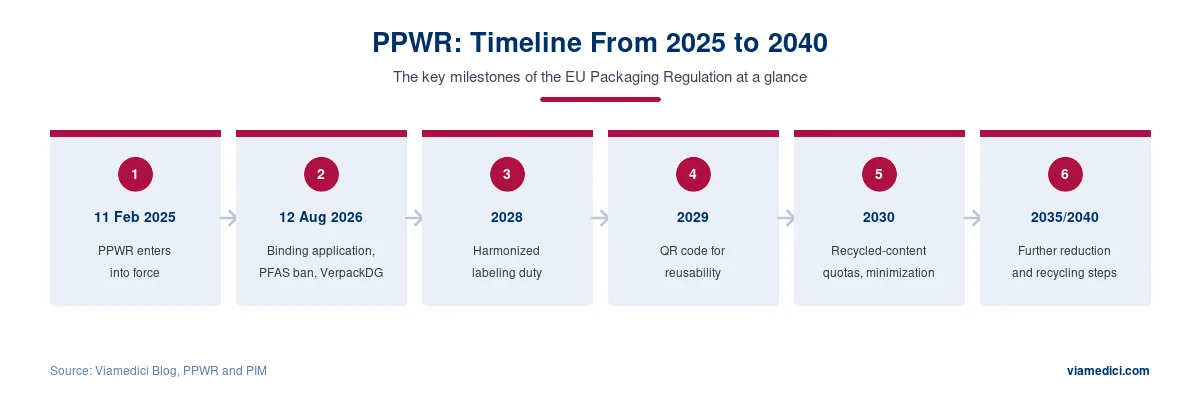
Timeline: The PPWR Deadlines That Actually Matter
Date
What happens
11 Feb 2025
PPWR formally enters into force
12 Aug 2026
Binding application across all EU member states. PFAS ban in food-contact packaging takes effect, along with the first substance and heavy-metal restrictions, and the baseline duties from Articles 12 and 15 become binding (see the next section).
From 2028 (no earlier than 12 Aug 2028, or 24 months after the relevant implementing acts, whichever is later)
Harmonized, clearly legible labeling on material composition becomes mandatory for newly placed packaging
From 12 Feb 2029 (or 30 months after the relevant implementing act, whichever is later)
For reusable packaging, additional reusability information must be accessible via a QR code or comparable data carrier. There is no general QR code duty for every package, this specifically targets reuse systems (Article 12 PPWR).
2030
First binding recycled-content quotas for plastic packaging under Article 7 (see table below), first packaging minimization requirements, first packaging waste reduction target
2035 / 2040
Packaging waste is meant to keep falling against the reference year, recycled-content quotas rise in further steps
2030 Recycled-Content Quotas Under Article 7, in Detail
Packaging Category
Minimum Recycled Content From 2030
Contact-sensitive PET packaging (excluding single-use beverage bottles)
30 percent
Other contact-sensitive plastic packaging
10 percent
Single-use plastic beverage bottles
30 percent
Other plastic packaging
35 percent
Here too, a later date from a relevant implementing act can partly apply, if one shifts the deadline. Only verified post-consumer recycled content counts toward the quota, pre-consumer scrap or production offcuts do not, regardless of how a supplier data sheet frames them.
What Already Applies Since 12 August 2026
Because the PPWR has applied directly since 12 August 2026, the following points are not a future topic, they are already mandatory:
Determine your own role per packaging type: manufacturer, importer, authorized representative, distributor, or fulfillment provider, each with different duties.
Make each packaging type or batch identifiable, so traceability is possible if needed.
State the manufacturer’s name, brand, and contact address on the packaging or in accompanying documentation.
Keep the EU declaration of conformity and the related technical documentation ready per packaging type, not created only on request.
Check environmental claims under Article 14 PPWR for evidence, blanket green claims without backing are no longer viable.
For food-contact packaging, be able to evidence PFAS thresholds through supplier documentation.
Why the PPWR Is Mainly a Data Problem
On a slide, PPWR sounds manageable: adjust materials, hit the recycled-content quota, print the right label, done. Where all that evidence is allowed to reside adds requirements on data location. In practice, packaging information in most organizations lives in scattered pieces. Suppliers hold the material composition, logistics tracks weights and packaging hierarchies, quality and regulatory teams keep certificates and lab reports, and marketing owns label copy and icons across languages. As long as this data is used internally and only occasionally, the patchwork holds together, awkwardly but well enough. PPWR changes that calculation: the same information now needs to be complete, accurate, current, and traceable across thousands of SKUs and packaging variants, on demand rather than after weeks of digging.
This shows up most clearly in consumer packaged goods, where a single manufacturer can easily manage several thousand packaging variants across markets. Companies that already struggled with inconsistent or outdated product data before PPWR will not see that problem disappear under the new proof burden, they will see it more clearly. The basics of what good data quality actually means still apply here unchanged: completeness, consistency, and currency are not a PPWR invention, the regulation just turns them from optional into mandatory.
Making things harder, packaging changes faster than the product itself. Film thickness gets adjusted, a carton switches to a higher recycled-content share, a label gets translated for a new market, often several times over a product’s life. Attributes and documents stay in constant motion while the underlying product does not change at all. That is what makes PPWR a stress test for the existing packaging data model, not the legal reading of the regulation itself.
What a PIM System Needs to Deliver for PPWR Compliance
To reliably prove that packaging meets requirements, packaging information needs to live in one place, structured, with clear ownership and traceable changes. Concretely, that means for the data model:
Packaging as its own data entity, not a free-text field on the product: primary, secondary, and tertiary packaging, materials, coatings, adhesives, each with its own attributes.
Clear links between products, packaging components, and suppliers, so a shared packaging element (a carton used for three SKUs, for instance) only needs to be maintained once.
Mandatory attributes for PPWR-relevant characteristics: material composition, recycled-content share, substances of concern (PFAS, heavy metals), recyclability classification, market-specific label text.
Version control and an audit trail for every change, so it can be shown on request which value was valid at which point in time.
Automated distribution of current data to ERP, compliance reporting, e-commerce, and supplier portals, instead of manual exports on request.
What that looks like in practice is illustrated by a PIM system for packaging data such as VIA/PIM360°: packaging as its own entity with an attribute model, approval workflow, and connections to downstream systems, instead of a pile of extra fields on the product.
PPWR and EPR: Related but Different Duties
PPWR and EPR (Extended Producer Responsibility) are often mentioned in the same breath, and they are more closely linked than it first appears. PPWR now also harmonizes extended producer responsibility at EU level, for instance in the baseline requirements for disposal systems. Registration, fee calculation, and actual system participation, however, still run nationally, in Germany through the VerpackDG and the central packaging register (ZSVR). Product-related PPWR requirements such as material composition, recycled content, and labeling on one side, and national EPR processes on the other, draw on partly the same packaging data but use it for different evidence and calculations: PPWR for the packaging’s own conformity, EPR for fees and the organization of disposal.
PPWR and the Digital Product Passport: Where Is the Difference?
Both regulations build on the same underlying idea, that companies can provide structured, machine-readable data on demand, but they cover different layers. The Digital Product Passport originates from the Ecodesign for Sustainable Products Regulation (ESPR) and covers the product itself: material composition, repairability, lifecycle data. PPWR covers the product’s packaging. For reusable packaging, it requires, from 12 February 2029 or 30 months after the relevant implementing act, whichever is later, reusability information accessible via a QR code or comparable data carrier, a narrower use case than the full product passport and not a blanket QR code duty for every package. Companies that already structure packaging data in their PIM today are laying a building block that extends naturally toward product passport requirements later, instead of starting from zero at the next regulatory wave.
PIM, MDM, DAM, and ERP: Who Holds Which PPWR Data?
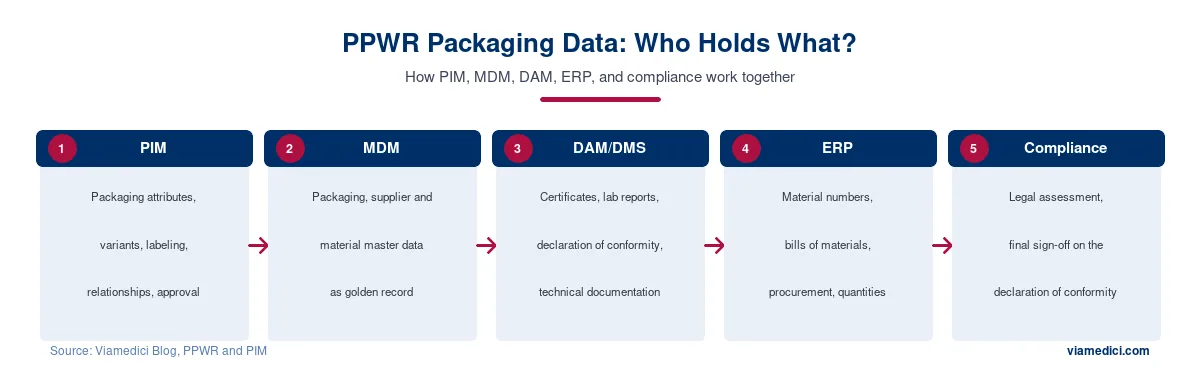
A PIM system does not deliver PPWR compliance on its own, and no vendor should claim otherwise. The proof burden realistically spreads across several systems that need to work together:
PIM: packaging attributes, variants, market-specific label text, relationships between products and packaging components, approval status.
MDM: packaging, supplier, and material master data as a golden record, so the same material definition does not drift slightly across multiple systems.
DAM/DMS: certificates, lab reports, declarations of conformity, and technical documentation as files, linked to the relevant packaging type in the PIM.
ERP: material numbers, bills of materials, procurement, and actual quantities, connecting the packaging data maintained in the PIM to day-to-day operations.
Compliance system or regulatory affairs process: the legal assessment itself and final sign-off on the declaration of conformity, fed by the structured data from the other systems.
PIM provides the structured data foundation and the relationships, but it replaces neither MDM for master data consistency, nor DAM for documents, nor the actual legal review.
Decision Matrix: Packaging Data in the PIM Model
Data Area
What Needs to Be Captured
Typical Ownership
Automatable Scope
Material composition
Materials, layers, shares per component
Supplier provides raw data, editorial team reviews
Medium, depends on supplier data quality
Recycled content
PCR share per packaging component, see Article 7 quotas
Procurement/supplier, confirmed by quality assurance
Medium, evidence often still manual
Substances of concern (PFAS, heavy metals)
Threshold-compliant evidence per material
Regulatory affairs/quality assurance
Low, lab reports mostly manual
Recyclability classification
Assessment per recognized methodology, once finalized
Sustainability team, externally reviewed
Low, official methodology reportedly still pending per trade sources
Market-specific labeling
Label text, pictograms, language per target market
Marketing/editorial team
High, once material data is structured
Declaration of Conformity (DoC)
Document per packaging type, based on technical documentation and supplier evidence (Articles 15, 18, Annex VII/VIII)
Manufacturer issues it, importers verify and keep a copy
Medium, generation from structured data is feasible, review stays manual
A Practical Example: One Package, Three Products, One Data Problem
A typical case from consumer goods practice shows where the problem starts. Three product variants share the same folding carton. The packaging supplier recently sent an updated spec with a higher recycled-content share and a slightly different material composition. Marketing has already updated the recycling icons and claim text on the packaging based on that spec. Sales, however, is still working from an internal sheet that still shows the old material and weight figures. Internally, this kind of drift often goes unnoticed for a while. Under PPWR, it becomes a direct compliance risk, because the question is no longer whether some information exists somewhere, but whether the information used everywhere is the same, current, and traceable back to its source.
Roles and Responsibilities: Who Maintains PPWR Data In-House?
Packaging data without named ownership tends to decay first. A Data Steward for the packaging domain monitors completeness and consistency of attributes day to day, flags gaps to the Data Owner, and makes sure an updated supplier sheet actually reaches every downstream system, not just marketing. Compliance or regulatory affairs stays responsible for the legal assessment, while the Data Steward secures the operational data maintenance, a division of labor that blurs quickly without clearly named roles. Naming those roles and the rules around them is the job of a data governance framework.
Step by Step: Building PPWR Readiness Into Your PIM
The first step is an honest inventory: where does packaging data live today, across how many spreadsheets, emails, and systems, and how current is it really? Next comes modeling: packaging gets represented as its own entity with clear attributes and relationships to products and suppliers, no longer an appendage on the product record. The third step defines mandatory fields and validation rules for PPWR-relevant attributes, so incomplete data cannot get approved in the first place. The fourth step names responsibilities, typically a Data Steward for the packaging domain. Only the fifth step automates distribution to ERP, compliance reporting, and external partners, building on a data foundation that is already solid by that point.
Common Mistakes When Preparing for PPWR
The most common mistake is still treating packaging data as a free-text field on the product instead of modeling it as its own, linked entity. The second mistake is continuing to run unversioned spreadsheets where nobody can say which row is currently valid. The third mistake is mentally blending PPWR and EPR, which misassigns ownership. The fourth, particularly costly mistake is assuming that once the August 2026 application date has passed, the topic is settled, while the more demanding labeling duties only start in 2028 and recycled-content quotas only in 2030, both of which need lead time.
Conclusion
PPWR is not solely a task for packaging development, procurement, and compliance. Getting it right also depends on whether packaging data is structured, versioned, and available on demand, and that is exactly what a well-set-up PIM delivers together with MDM, DAM, and the compliance process. Companies that build this foundation now can produce evidence on request instead of scrambling for it under deadline pressure, and can face the 2028 and 2030 deadlines with correspondingly more calm.
The PPWR entered into force on 11 February 2025 and has applied directly across all EU member states since 12 August 2026. Further requirements, such as harmonized labeling and recycled-content quotas, phase in through 2030 and beyond.
PPWR governs how packaging must be designed and declared before it is placed on the market. EPR governs financial responsibility for disposal, run through national fee systems. Both need the same data foundation but serve different purposes.
No. The EU declaration of conformity is generally issued by the manufacturer for the relevant packaging type and backed by technical documentation. Importers and other economic operators have their own verification, record-keeping, and information duties, but they do not issue the declaration themselves. Which role a company holds for a given packaging type should be determined individually and, where in doubt, confirmed with a compliance lawyer.
Both rest on the same principle of structured, machine-readable data on demand, but cover different layers: the product passport covers the product itself, PPWR covers its packaging. Structuring packaging data now leaves companies better prepared for product passport requirements later.
A PIM system turns packaging into its own structured data domain with clear relationships, version control, and automated distribution. That does not replace legal review, but it turns the proof burden into something manageable instead of a permanent fire drill.
We use cookies and similar technologies to ensure the functionality of our website and to improve content. We use cookies and similar technologies to ensure the functionality of our website and to improve content. For the latter, pseudonymised data from visitors is collected, e.g. analysed for purposes of statistics passed on to partners for remarketing. By clicking “Accept all”, you consent to the storage and reading of information on your end device and to the further processing of personal data (e.g. your IP address) and potentially its transmission to services, including in third countries. By selecting “Strictly necessary for technical purposes”, you refuse the use of services that require consent. You will find details under “Customise”, and the option to consent to individual categories.. You can revoke consent you have given at any time via “Privacy settings” in the Privacy policy.
Please select your language before accepting cookies :
Mandatory
Always active
These cookies are needed for a smooth operation of our website.
External
Content from video and social media platforms is blocked by default. Consent to external media here to view all external media without further manual approval.
Statistics
The technical storage or access that is used exclusively for statistical purposes.The technical storage or access that is used exclusively for anonymous statistical purposes. Without a subpoena, voluntary compliance on the part of your Internet Service Provider, or additional records from a third party, information stored or retrieved for this purpose alone cannot usually be used to identify you.
Marketing
The technical storage or access is required to create user profiles to send advertising, or to track the user on a website or across several websites for similar marketing purposes.