Workflow | Portals (Supplier Portal, Media Portal, Sales Portal | AI (product expert/co-pilot/auto-translation) | Digital Shelf |
Media Management | Sustainability(DPP & EPD) | SAP
Workflow | Portals (Supplier Portal, Media Portal, Sales Portal | AI (product expert/co-pilot/auto-translation) | Digital Shelf |
Media Management | Sustainability(DPP & EPD) | SAP
What Is a Single Source of Truth? How PIM and MDM Make It Possible
Share This Post
Table of Contents
A single source of truth is the practice of mastering each piece of information in exactly one authoritative place, so that every system and every team works from the same data instead of from competing copies. For a B2B manufacturer or distributor that principle is the difference between a product that looks identical in the webshop, the B2B portal, the marketplace and the print catalogue, and one that shows four different prices. This article explains what a single source of truth really means, how it differs from neighbouring concepts, and how a PIM and an MDM system turn the idea into day-to-day reality.
What Is a Single Source of Truth?
In information systems, a single source of truth (SSOT) means structuring your data so that every element is created and edited in one canonical location. Other systems do not keep their own private versions; they reference the authoritative one. The payoff is simple to state and hard to achieve: when a value changes once, it is correct everywhere, and nobody has to ask which spreadsheet is the real one.
It helps to be honest about the limits. A perfect SSOT is rare in practice, because most companies run an ERP, a CRM, a webshop and a handful of legacy tools that each need a working copy of the same product or customer. The realistic goal is not to abolish every copy. It is to designate one trusted origin for each data element and to keep every copy in sync with it.
SSOT vs. single version of truth, golden record and system of record
These four terms get used interchangeably, which causes most of the confusion. The table below keeps them apart.
Expression
Meaning
Single Source of Truth (SSOT)
The architectural goal: every data element is mastered and edited in one place; other systems reference it.
Single Version of Truth (SVOT)
The pragmatic reporting view: copies exist in several places, but one location (often a data warehouse) is treated as authoritative for analysis.
Golden Record
The single, consolidated record for one entity (one product, one customer), assembled from the most trusted attributes. The output of mastering.
System of Record (SoR)
The native origin system for a given element, for example the ERP for stock or the CRM for contacts. An SSOT draws from the systems of record.
Put plainly: the system of record is where data is born, the golden record is the clean result for one entity, the SSOT is the architecture that keeps it authoritative, and the SVOT is the reporting compromise most warehouses settle for.
Why a Single Source of Truth Matters
Fragmented data is expensive, and the numbers are sobering. Gartner has estimated the average cost of poor data quality at 12.9 million US dollars per organisation each year. MIT Sloan Management Review, drawing on work by Thomas C. Redman, puts the loss at the equivalent of 15–25 % of revenue for most companies. Both are estimates, but they point the same way.
For a manufacturer the benefits land in concrete places. Sales teams quote from the same prices the shop displays. Marketing publishes specifications that match what engineering signed off. New products reach every channel faster, because the data is enriched once and syndicated everywhere rather than re-keyed per system. There is also a forward-looking reason that has moved up the agenda in 2026: reliable AI needs a reliable foundation. An assistant that answers questions about your products is only as trustworthy as the data underneath it, and that data has to come from a single source.
What Is Identity Resolution?
Before a golden record can exist, a system first has to recognize that two or more records describe the same entity — the same customer, supplier, or product. That’s identity resolution: the matching process that turns “Mueller GmbH, Main St. 1” and “Müller GmbH, Main Street 1a” into one connected record instead of two duplicates.
Two methods are used. Deterministic matching links records via unique keys like a customer number, GLN, or tax ID — fast, but only as reliable as those keys. Probabilistic matching scores the similarity of attributes such as name, address, and contact details, which is essential when spelling variations or different source systems are involved.
Once records are matched, merge and survivorship rules decide which value wins in a conflict — the most recent, the most trusted, or a manually approved one. Only then do multiple raw records become the one golden record distributed as the single source of truth.
In our master data management software VIA/MDM, this matching runs automatically across customer, supplier, and product master data, combining deterministic and probabilistic matching with configurable survivorship rules.
How PIM and MDM Create a Single Source of Truth
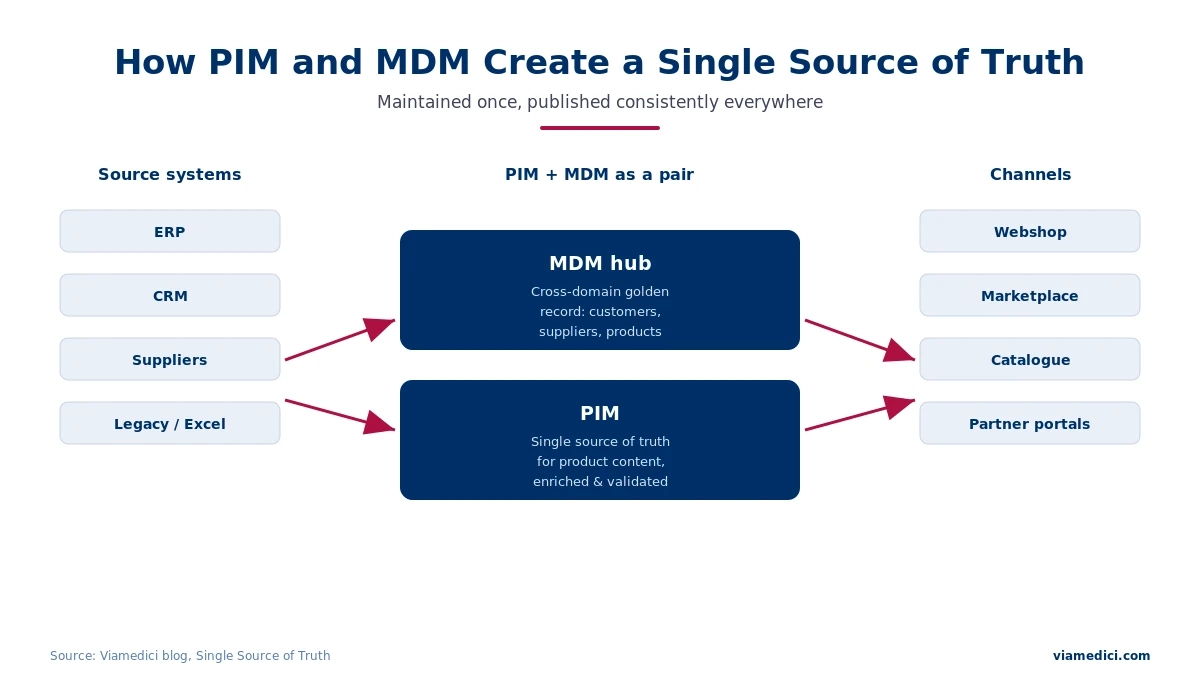
This is where the abstract idea becomes operational. Master Data Management governs the critical master data that many systems share, such as customers, suppliers and products, and produces a governed golden record for the enterprise. A PIM does the same job for product information specifically, then enriches and structures it for selling and syndicates it to every channel. A useful way to remember the split: MDM builds the record for the enterprise, while PIM builds it for the market.
In practice the two work as a pair. The PIM is the single source of truth for the product content that feeds external channels, maintained once and pushed to the webshop, the marketplace and the catalogue through real-time interfaces. The MDM hub keeps cross-domain master data consistent and feeds internal systems and reporting. For Viamedici customers the picture extends further, because the same governed foundation also serves media through a DAM and configurable products through a CPQ engine. One change to the master, and the webshop, the sales portal and the configurator all reflect it, which is exactly how a PIM keeps product information quality high across the board.
Common Challenges on the Way to a Single Source of Truth
Most SSOT projects stall for predictable reasons, and naming them early saves months. Without clear data governance rules, any single source of truth drifts back into silos over time. Data silos are the usual culprit, where information stays trapped in a department system and never reaches the shared source. Legacy applications resist integration, and now and then replacing one is cheaper than maintaining the workarounds around it. The same field turns up in fifteen different formats across systems, so units, date formats and naming all need standardising before anything can merge. Duplicates pile up without unique identifiers, turning one customer into three. The quietest failure is the absence of clear ownership: without a named steward who is accountable, quality slips back as soon as the project team moves on. Real-time synchronisation between the hub and the source systems is the technical hurdle that ties all of this together.
How to Implement a Single Source of Truth
A phased approach beats a big-bang rollout, and this is the one place where a numbered sequence genuinely helps. Before merging sources, you should measure data quality and clean up duplicates.
Map the critical data sources, including the shadow IT that daily users rely on but leadership rarely sees.
Set governance and ownership around business needs, naming an accountable owner and stewards for each domain.
Choose a scalable, multi-domain platform such as a PIM for product data and an MDM hub for shared master data.
Cleanse, standardise and consolidate the records into one trusted version per entity.
Connect the integrations and real-time sync so the clean record flows back to every source system.
Pilot on one domain, then roll out, train users, and monitor quality with KPIs so the source stays trustworthy.
Is a Single Source of Truth Even Achievable?
It is a fair question, and the honest answer is nuanced. A literally perfect single source, with zero copies anywhere, is rarely realistic in an enterprise that runs dozens of systems. What is achievable, and what actually delivers the value, is a single authoritative origin for each data element plus disciplined synchronisation of every copy. Aim for that, not for purity, and judge success by whether the business can trust the data, not by whether a copy exists somewhere.
It is a setup where each piece of data is mastered in one authoritative place, so every system and team works from the same information rather than from conflicting copies.
The golden record is the clean, consolidated record for one entity, such as a single product. The single source of truth is the wider architecture that keeps those records authoritative across the organisation.
Both play a part. The PIM is the source of truth for the product content that feeds sales and marketing channels, while MDM governs shared master data across many systems. In practice they work together.
Identity resolution is the matching process that recognizes when different records from separate source systems describe the same real-world entity, such as the same customer or supplier, and merges them into a single record. It combines deterministic matching through unique keys with probabilistic matching across similar attributes, and it is the prerequisite for turning multiple raw records into a golden record.
Master data management software such as VIA/MDM imports customer data from every connected source system (CRM, ERP, portals), uses identity resolution to determine which records belong to the same customer entity, merges them according to defined rules, and distributes the resulting golden record centrally back to sales, marketing, and service, so every team works from the same, current record instead of department-specific copies.
It reduces them sharply by giving every system one authoritative origin to reference, but the realistic goal is synchronised copies around a trusted source, not the complete absence of copies.
A single source of truth is less a product you buy than a discipline you maintain. Decide where each data element is mastered, govern it with clear ownership, and let a PIM and an MDM system enforce it for product and master data. Get that right and the data stops being a source of arguments and starts being something the whole business can build on.
We use cookies and similar technologies to ensure the functionality of our website and to improve content. We use cookies and similar technologies to ensure the functionality of our website and to improve content. For the latter, pseudonymised data from visitors is collected, e.g. analysed for purposes of statistics passed on to partners for remarketing. By clicking “Accept all”, you consent to the storage and reading of information on your end device and to the further processing of personal data (e.g. your IP address) and potentially its transmission to services, including in third countries. By selecting “Strictly necessary for technical purposes”, you refuse the use of services that require consent. You will find details under “Customise”, and the option to consent to individual categories.. You can revoke consent you have given at any time via “Privacy settings” in the Privacy policy.
Please select your language before accepting cookies :
Mandatory
Always active
These cookies are needed for a smooth operation of our website.
External
Content from video and social media platforms is blocked by default. Consent to external media here to view all external media without further manual approval.
Statistics
The technical storage or access that is used exclusively for statistical purposes.The technical storage or access that is used exclusively for anonymous statistical purposes. Without a subpoena, voluntary compliance on the part of your Internet Service Provider, or additional records from a third party, information stored or retrieved for this purpose alone cannot usually be used to identify you.
Marketing
The technical storage or access is required to create user profiles to send advertising, or to track the user on a website or across several websites for similar marketing purposes.