


PIM Software for Mechanical Engineering: More Efficiency and Better Data Quality for Digital Sales
One central data backbone for engineering, variant configuration and the spare parts business: precise, consistent and always in sync between engineering, ERP and sales, instead of spread across several parallel point solutions.


VIAMEDICI SOLVES
In mechanical engineering, the number of systems often grows faster than data quality: engineering (CAD/PLM), ERP, translation tools, catalog solutions and sometimes several parallel PIM instances per plant or country organization. The result is inconsistent product data, duplicated maintenance and uncertainty about which version is the right one.
There is no room for error here. An outdated bill of materials or a wrongly assigned spare part can bring a customer plant to a standstill or cause costly rework, especially when engineering, ERP and sales data are not consistent.
This is why well-known machine builders such as TRUMPF rely on central product data software rather than fragmented individual tools. Without that single reliable source, it becomes hard to keep variant complexity, the spare parts business and international sales channels under control at the same time. That is exactly where we come in.
We Have Solutions to Your Most Challenging Problems
Across plants, brands and country organizations, several parallel PIM and catalog systems often exist side by side: grown historically, maintained differently, updated at different times. The result is inconsistent data quality and uncertainty about which version currently applies.
Viamedici EPIM consolidates distributed product data sources into one central golden record, as a migration path for existing point solutions rather than yet another system on top of them. All plants and country organizations then work from the same validated data basis, alignment loops between sites disappear, and you always know which data version is currently valid.
Operating manuals, spare parts lists and technical drawings have to stay current, multilingual and clearly assigned to a machine configuration across the entire machine lifecycle, often 15 to 20 years.
viaPUBLISH generates media-neutral spare parts catalogs and technical documentation from a single data source. TMS integrations (DeepL, Across, Trados) produce consistent multilingual content without duplicated maintenance, including rollouts across many languages and countries. This shortens the time from a product change to updated, multilingual spare parts information in the field, instead of updating every language version by hand.
Machines and plants are frequently configured to customer specifications, from select-to-order through to engineer-to-order. Without structured rules, this leads to inconsistent quotes, incorrect bills of materials and long alignment loops between sales and engineering.
The Smart Product Configurator maps configuration logic, options and dependencies on a rule basis and is closely linked to VIA/PIM360° and the engineering side, delivering valid quotes in real time as soon as the product kit becomes too complex to handle manually. The time from customer request to binding quote drops, and faulty configurations that would only surface in production are ruled out from the start.
Machine builders often run SAP-centric system landscapes and have to keep bills of materials, variants and technical attributes in sync between engineering, ERP and sales channels.
Bidirectional integration with SAP and S/4HANA keeps product master data, bills of materials and variant logic consistent between engineering, ERP and every downstream channel, with no manual double maintenance. Reconciling engineering, ERP and sales by spreadsheet or email is no longer necessary, and engineering changes are immediately visible wherever they are needed.
Safety-relevant components and machines require fully documented, versioned product data and proof of conformity that can be found quickly when it matters.
Integrated rule engines validate mandatory attributes before publication. Versioning and history ensure it is always traceable which data version applied to which machine configuration. In an audit or a complaint, you can provide answers in minutes rather than days, with complete evidence of the exact data version for every machine delivered.
Machines and spare parts are sold through direct sales, channel partners, service technicians and e-commerce catalogs, in some cases classified according to industry standards such as ETIM or ECLASS. Every channel needs complete, current data.
A golden record is maintained once and distributed to all channels via viaCONNECT, including structured classification for trading platforms and spare parts shops wherever the channel requires it. A new machine or spare part reaches every sales channel at the same time, instead of weeks later because each channel has to be served separately.
Explore Our Solutions
PLATFORM
Viamedici EPIM
The solution for multi-domain MDM. PIM 360, DAM and CPQ
PRODUCT
VIA/MDM
Master Data Management
PRODUCT
VIA/PIM360°
Product Information Management
PRODUCT
VIA/DAM
Digital Asset Management
PRODUCT
VIA/Configuration (CPQ)
Configure Price Quote
Book a demo to get started
Let us show you how Viamedici’s solution sets will change your business for the better
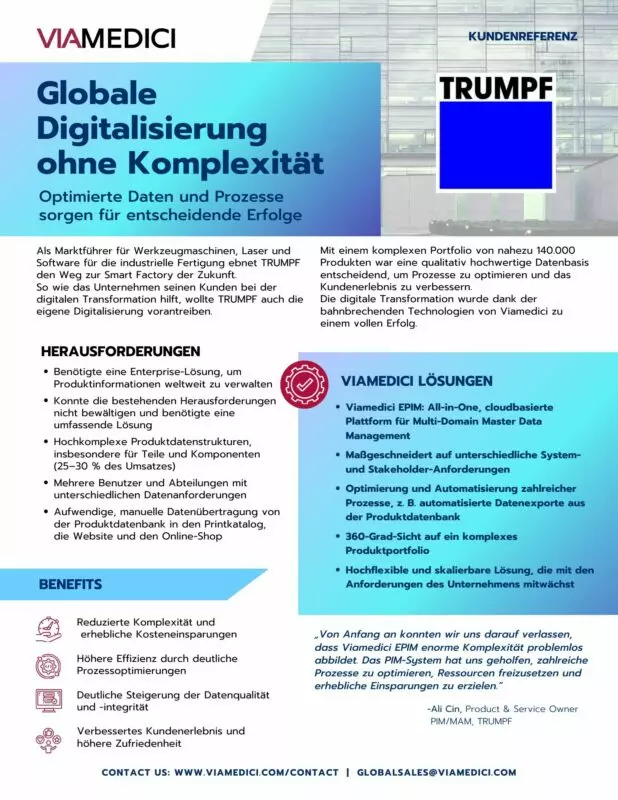
TRUMPF Case Study: Global Digitalization Without the Complexity
Optimized data and processes deliver substantial gains for a leading machine tool and laser technology manufacturer.
FAQs
A PIM system (product information management) brings together all product data in mechanical engineering: engineering data, variant logic, spare parts relationships and technical documentation. It creates a single source of truth that engineering, sales, service and channel partners can access in real time.
Yes. A typical pattern in mechanical engineering is a landscape of several parallel PIM and catalog tools that has grown across plants, brands or country organizations. Viamedici EPIM serves as the target platform for consolidating them into a single golden record, with a structured migration path instead of another system on top of the existing ones.
Viamedici maps configuration rules, options and dependencies in a structured way and connects them to the Smart Product Configurator (SPC). This produces valid, quotable machine configurations in real time instead of manual alignment between sales and engineering, as soon as the product kit is complex enough to justify it.
Pure catalog tools generally only manage the output of product data, without their own master data management (MDM) or configuration logic. As the product portfolio or the number of variants grows, such tools hit structural limits. Viamedici EPIM combines catalog capabilities with MDM and native configuration (CPQ) from the outset, in one platform rather than several connected tools.
Yes. Viamedici EPIM offers bidirectional integration with SAP and SAP S/4HANA. Bills of materials, variant logic and technical attributes stay in sync between engineering, ERP and all downstream channels.
viaPUBLISH generates media-neutral spare parts catalogs and technical documentation from a single data source, including automated translation via TMS integrations. Even after 15 to 20 years of machine service life, all spare parts information stays unambiguous and current.
TMS integrations (DeepL, Across, Trados) and decentralized editing rights keep product data centrally consistent while individual country organizations or teams still add and maintain their own local content, including multilingual catalogs and documentation for double-digit numbers of languages.
Migration runs step by step along a structured migration path rather than as a one-off big bang: existing data sources are connected and transferred one after another while catalogs, the spare parts business and sales channels keep running throughout. Even a fragmented landscape that has grown over years can be replaced without interrupting day-to-day business or customer communication.





