Dark PIM is product knowledge that exists in a company but sits outside the PIM or cannot be used there in structured form. It covers spreadsheets in sales, PDF data sheets, certificates in file folders, long texts in the ERP and what application engineers carry in their heads. Customers, distributors and AI systems see none of it. This article shows where that knowledge sits and how manufacturers can bring it into the PIM step by step.
What is dark PIM?
The term was coined by Viamedici and builds on two established concepts. Dark data refers to data that companies collect and store but do not use further. Splunk uses a slightly broader definition that also includes data companies do not even know they have. In an older but widely cited Splunk survey from 2019 of more than 1,300 business and IT leaders, respondents estimated this share at 55 percent of their data. Shadow IT, according to the lexicon of the German Informatics Society, means systems that are neither technically nor strategically integrated into a company’s IT service management.
Dark PIM is the product data version of both. The knowledge exists, often in good quality. It simply sits in places where neither an online shop nor a distributor feed nor an AI assistant can reach it.
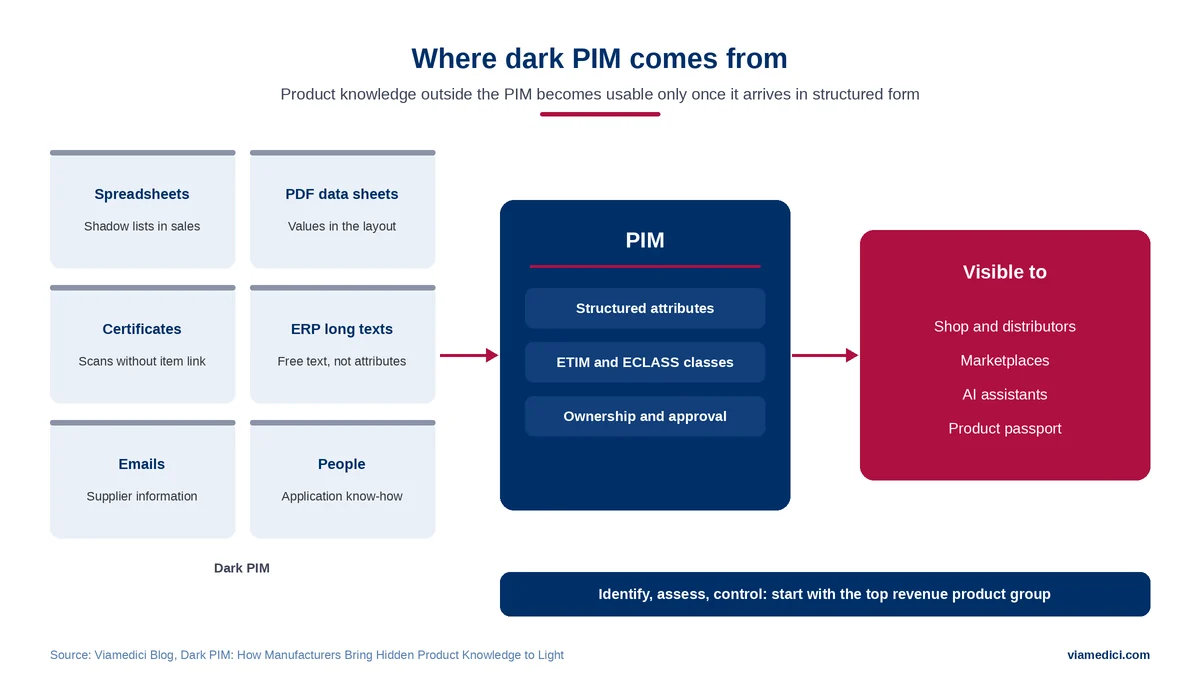
Where dark PIM comes from
Many industrial companies have the same locations.
| Location | Typical example | Why it stays invisible |
|---|---|---|
| Shadow spreadsheets | Sales team’s technical list with its own columns | No link to the PIM, unclear version |
| PDF data sheets and catalogs | Performance curves, installation dimensions | Values sit in the layout, not in attributes |
| Certificates and declarations | Declaration of conformity as a scan | Not linked to the item |
| Long texts in the ERP | Free text with material and tolerances | Not filterable, not translatable |
| Supplier emails | Material information in attachments | Never reach the PIM |
| People’s heads | Operating limits only application engineering knows | Leave with the person |
Much of this grew organically over the years. The sales spreadsheet often appeared because the PIM could not hold certain values or because getting them there was too cumbersome. Anyone who wants to reduce dark PIM needs to know these reasons. Otherwise, the next spreadsheet appears.
Why it gets expensive for manufacturers
The consequences are spread across many places. Distributors require classified attributes according to ETIM or ECLASS. If they are missing, the item is harder to find in the distributor’s shop or not listed at all. For variant products, conflicting values from two sources can lead to wrong orders. And for the Digital Product Passport, information has to be available in structured form that today often exists only as a PDF.
Then there is the dependence on individual people. The lexicon gives a typical shadow IT example: a price calculation in an Excel spreadsheet that nobody could operate when the employee was absent. Product knowledge works the same way.
AI makes the issue more urgent. Assistants and agents that access the PIM through an MCP server, for example, can only work with knowledge that is available in structured form. Whatever sits in dark PIM does not exist for them. More on this in the article on AI in PIM. Product experience management reaches its limits here too: a manufacturer’s technical depth only becomes visible in the channels once it has reached the PIM.
How to measure your dark PIM share
A decision about effort needs a number. The most direct way to measure the dark PIM share is a sample comparison: for a set of items, check how many mandatory attributes appear in the data sheet or ERP long text but are missing in the PIM. It also pays to count the shadow spreadsheets per product group.
Three metrics from the PIM itself show where the gaps have an effect. Completeness per target channel comes first. An item can be complete for your own shop and incomplete for a distributor feed, and an overall rate hides exactly that. Next is the share of values in free-text fields, because whatever sits in prose cannot be used for filters, comparisons or feeds. Finally, the age of the last change per item helps. Products left untouched for years are the most likely place to find outdated information.
A sample is enough to start, as long as it covers the typical variants of a product group. Suppose a manufacturer compares ten data sheets for a pump series with the PIM. It turns out that material information and operating temperatures appear almost only in the PDFs, and approvals sit only in a file folder. That makes clear which two attribute groups belong in the PIM first and who has to supply them. The article on data quality describes how to define such metrics properly.
Reducing dark PIM: identify, assess, control
The lexicon describes a three-step approach for shadow IT that transfers well. First identify: which spreadsheets, folders and documents contain product knowledge, and who maintains them? Then assess: which knowledge is missing in which channel, and which product group carries the most revenue? Start there.
Only then comes control. New attributes are created in the PIM before anyone opens a new spreadsheet column. Supplier data arrives through a PIM supplier portal instead of by email. AI can now propose values from PDF data sheets, often reliably when the layout is clean. They are only applied after business review. And for every product group it is clear who keeps the data complete. Often that is a data steward.
Spreadsheets do not have to disappear. As an exchange format with suppliers or for a quick analysis, they remain useful. They just should not be the system that holds the valid values.
Why dark PIM initiatives fail
Implementation usually fails on four recurring points, and none of them is technical. Often nobody is responsible: product data sits between product management, marketing and sales, and no role is tasked with keeping it complete. Frequently, data is cleaned up once instead of being governed permanently, and new items are created in the old pattern again. Anyone who tackles the entire catalog at once rarely gets through. And if supplier data is left out, the gap keeps filling up from outside.
What does not belong in the PIM
Not every piece of knowledge has to go into the PIM. Calculations belong in the ERP, project knowledge in the CRM and sales arguments in sales and marketing materials. The goal is that every piece of information a customer, distributor or system needs about a product has one clear place and is maintained in structured form.
How Viamedici EPIM/5 helps
In Viamedici EPIM/5, product, master and media data sit in one shared platform. Classifications according to ETIM and ECLASS, variants, certificates and CAD files can be linked to the item. A data quality index shows for each item where information is missing, and suppliers deliver their data into the platform through VIA/Portals, validated and after approval. Central maintenance is handled by the PIM system VIA/PIM360°.
Conclusion
Dark PIM usually grows out of missing responsibility and inconvenient routes into the PIM. Starting with the product group that carries the most revenue and changing the rules for new items makes hidden knowledge usable step by step.