Product Experience Management (PXM) is the channel-specific preparation, delivery and performance measurement of product information, so that it convinces in your own shop, in a distributor’s portal, on marketplaces and in catalogs. PXM builds on a PIM system. The PIM makes data correct and complete. PXM makes it fit the place where people buy. For B2B manufacturers, this is above all a question of control, because most of those channels do not belong to them.
What does PXM mean?
PXM is short for Product Experience Management. The analyst firm ISG Research describes it as the methods and processes for managing customer experiences using systems that support product-related processes, to meet the needs of consumers, customers, partners and suppliers (ISG Buyers Guide for Product Experience Management 2025).
Analysts such as ISG assess PXM as a software market. In practice, it is above all a way of working. It includes preparing content per channel, delivering it through feeds, adapting it to target groups and measuring how well product information performs in each channel.
PXM and PIM: what is the difference?
The short formula: PIM manages product data, PXM shapes how it performs. Without a clean PIM, there is no good product experience, only nicely packaged errors.
| Discipline | Core question | Typical content |
|---|---|---|
| PIM | Is the product data correct and complete? | Attributes, classifications, copy, relationships |
| PXM | Does the data work on each channel? | Channel copy, image selection, feeds, content quality per channel |
| DAM | Are the right media available? | Images, videos, CAD, documents with rights |
| CMS | What does the website look like? | Pages, layout, editorial content |
| CDP | Who is the customer? | Customer profiles, behavior, segments |
| CXM | How does the customer experience the company overall? | Service, communication, all touchpoints |
What does not belong to PXM matters just as much. Prices, stock levels and customer data come from ERP and CRM. PXM uses them but does not manage them. The media themselves sit in digital asset management. PXM only decides which image comes first on which channel.
What PXM includes
Channel-specific content
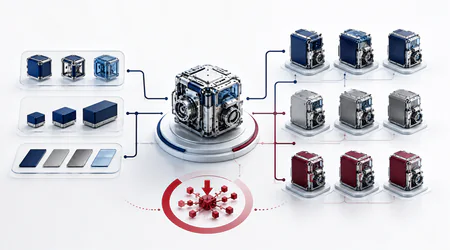
The same contactor needs different information for electrical wholesale than for your own shop. The wholesaler expects ETIM attributes, the shop an understandable benefit-led copy, the planner a 3D model. PXM means maintaining these versions deliberately instead of writing one text for everyone.
Syndication and feeds
Product data goes to trade partners in formats such as BMEcat, to marketplaces and price comparison sites as feeds, or to partner portals through interfaces. Each recipient has its own mandatory fields and limits. Generating feeds automatically from the PIM instead of reworking export lists by hand saves time and prevents channels from showing different versions.
Context and target group
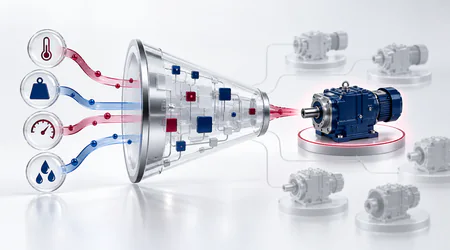
An installer looks for technical values and installation notes, an architect for dimensions, surfaces and BIM data. Good product pages bring different content to the front depending on the audience. In B2B this does not have to be real-time personalization. Often it is enough to define, for each target group, which attributes, images and documents appear at the top.
Measurement on the channel
Digital shelf analytics checks how products actually appear at the distributor or on the marketplace: complete, with the right image, with the correct price. This is the part most often missing, because without that feedback the manufacturer does not know what happened to its data.
PXM in B2B: the manufacturer does not own the channel
In B2C, the most important channel often belongs to the manufacturer. In B2B, it is different. A large share of product pages is created at the wholesaler, in a distributor’s portal or in the customer’s procurement platform. The manufacturer supplies the data, someone else controls the presentation. Where it runs the channel itself, such as its own shop, guided product selection through needs-based questions comes into play.
Here, PXM means delivering data so that it still works well on someone else’s channel. That starts with standards. ETIM organizes technical products into classes with defined attributes, and BMEcat is the XML exchange format for B2B catalog data. Gaps here mean your product simply drops out of filtered searches in the wholesale portal.
| Channel | What it requires | Example: contactor |
|---|---|---|
| Electrical wholesale | ETIM class with mandatory attributes, BMEcat delivery | Rated current, coil voltage and number of poles as ETIM values |
| Google Shopping | Title up to 150 characters, description up to 5,000 characters, GTIN (where available), up to 10 additional images (Google) | Title with brand, type and key value |
| Own shop | Benefit-led copy, image gallery, documents, accessories | Application example, wiring diagram, matching auxiliary switches |
| Planners and configurator | Dimensions, 3D data, combination rules | CAD model, permitted combinations |

How do you measure whether PXM works?
The promises around PXM are big, the evidence often thin. Many studies showing higher conversion or fewer returns come from consumer retail and do not transfer easily to B2B. Your own metrics with a before-and-after comparison are more reliable.
| Metric | Data source |
|---|---|
| Completeness per channel | Validation rules in the PIM, mandatory fields per recipient |
| Rejected records in feeds | Feedback from marketplaces and wholesalers |
| Time to channel approval for new products | Workflow timestamps |
| Product data questions to sales and inside sales | Ticketing system or CRM |
| Returns with reason “description did not match” | Returns management |
If you capture these values before you start, you can show reliably after a few months what has improved, without relying on industry statistics.
AI and new channels
Part of product search can be expected to run through AI assistants, and procurement will add agents that compare offers on their own. These systems read structured attributes more reliably than marketing prose. For PXM, that means clean attributes become more important, not less. The articles on agentic commerce and AI in PIM go into more detail. How such systems access the PIM in a controlled way is covered in the article on the MCP server.
Mandatory information is part of the product experience
The experience also includes what customers and authorities require. Since 28 June 2025, the German Accessibility Strengthening Act (BFSG), which implements the European Accessibility Act, has applied, covering consumer online shops among others. The German Federal Government cites image captions that can be read aloud as an example. For manufacturers with a consumer shop, alt text thus becomes an attribute that should be maintained in the PIM. The same applies to sustainability data that the Digital Product Passport will require.
Limits of PXM
PXM is no substitute for data quality. Personalization also needs customer data that does not live in the PIM, and therefore a connection to CRM or CDP. And vendors use the term “PXM software” in very different ways. Before selecting a tool, ask which of the tasks above it actually covers.
Common mistakes in PXM projects
The most common mistake is starting with the surface. New channel copy, often AI-generated, looks good quickly but rests on incomplete attributes. The wholesaler still filters by ETIM values, and the product is still missing there.
A second mistake concerns the schedule. Trying to optimize every channel at once spreads the effort so thin that no measurable effect appears anywhere. Missing feedback adds to this: without information on which records a recipient rejects or displays incorrectly, the team is working blind. And variants are often forgotten. A product with 40 variants needs rules on which copy and images are inherited and where each variant needs its own content.
How manufacturers get started with PXM
A PXM project does not have to start with new software. A pilot with a single channel, usually the one with the highest revenue, has proven effective.
The first step is mapping that channel’s requirements as mandatory fields in the PIM, for example the ETIM attributes the wholesaler uses for its filters. Next comes measuring the starting point: how complete is the data today, how many records does the recipient reject, how long does it take for a new product to become visible there? Only then are channel copy, image selection and the feed automated.
After three to six months, the comparison with the baseline shows whether the effort pays off. With that experience, the next channel can be connected much faster, because rules and responsibilities are already in place.
Who is responsible for PXM?
PXM rarely fails because of technology, more often because of unclear responsibilities. Product management owns the technical attributes, marketing the copy and images, e-commerce or sales the channel requirements. Someone has to bring these views together and decide which version goes where. In many companies, a data steward or a product content team with clear approval rules takes on this role.
When is a PIM enough, and when do you need more?
For many B2B manufacturers, the most sensible path is step by step. First comes a PIM with complete, classified data. Then channel-specific versions and automated feeds for the most important recipients. Only after that do digital shelf analytics or dedicated PXM tools pay off, usually where marketplaces or large distributors account for a significant share of revenue. Recurring questions from distributors or high rejection rates in feeds are a good indicator.
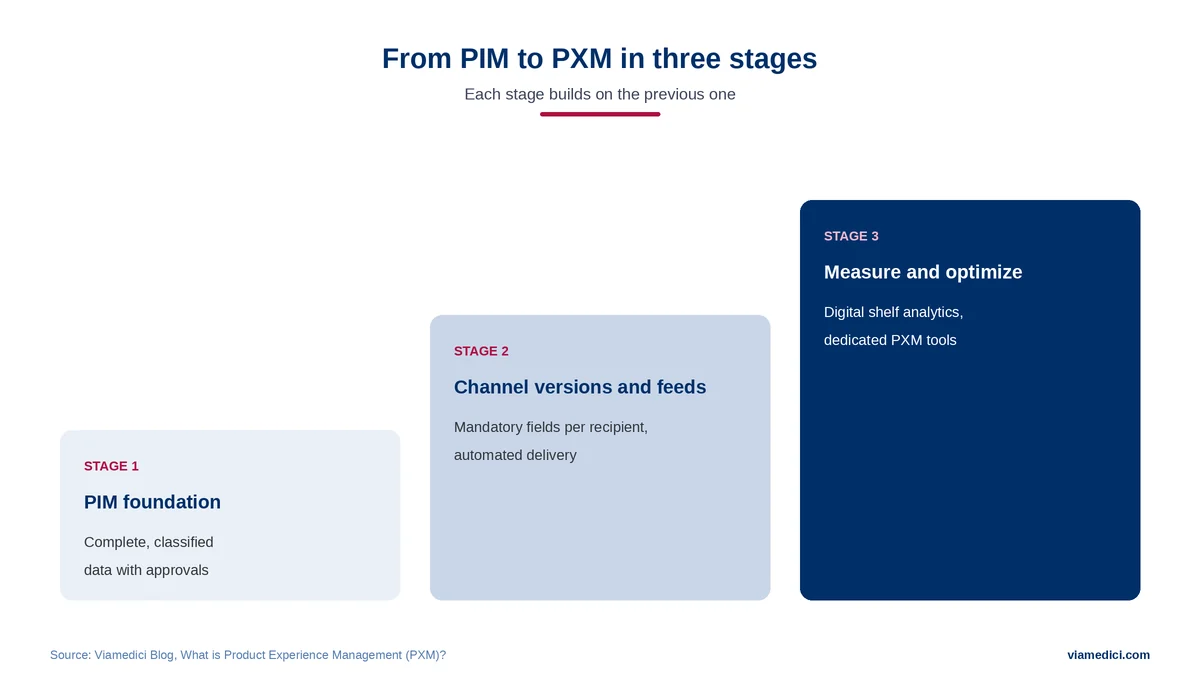
Modern PIM platforms already cover the first two stages. In its Buyers Guide for Product Experience Management 2025, ISG Research rated Viamedici as “Innovative”. The product assessed was the PIM system VIA/PIM360°.
Conclusion
Product Experience Management turns correct product data into convincing product information, tailored to each channel. In B2B, the biggest task is serving channels well that the manufacturer does not own. That works with clean standards, clear metrics and a PIM as the foundation.