Table of Contents
AEO is currently the term agencies and tool vendors use to justify new budgets. Answer engine optimization is meant to get your content into AI answers rather than just into the classic results list. For manufacturers and distributors, though, the debate usually starts in the wrong place. Whether ChatGPT, Perplexity or Google’s AI Overviews describe your product correctly depends less on how a blog article is phrased than on whether complete, consistent and machine-readable product data about it exists. This article explains what AEO is, which tactics hold up against the evidence, and what product data has to deliver so that answer engines can find, compare and recommend your products.

What is AEO?
AEO stands for answer engine optimization and describes measures intended to make content visible in direct answers, meaning AI Overviews, Google AI Mode, ChatGPT, Perplexity or Copilot. Unlike classic search, AEO does not aim at a position in the results list but at being named or cited within the answer itself.
The term has no defined originator. It migrated from the vocabulary of featured snippets and voice search into the AI context and was subsequently claimed by tool vendors, which is why definitions across the market contradict each other.
AEO, SEO and GEO: the terms separated properly
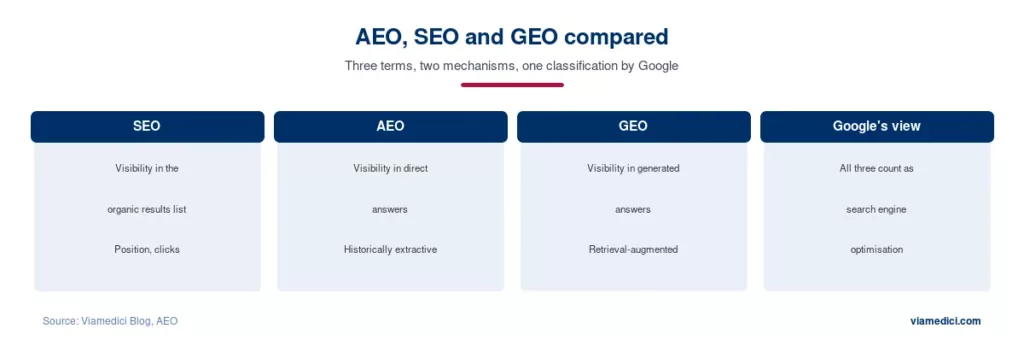
Unlike AEO, GEO has a clear origin. The term generative engine optimization comes from a 2023 research paper by Aggarwal and colleagues, published at the ACM conference KDD 2024 (arXiv 2311.09735). AEO, by contrast, is a market coinage. Anyone reading that GEO is the umbrella term and AEO the subset will find the exact opposite claim elsewhere. SEO remains the foundation of both, because an answer engine can only draw on sources it has retrieved in the first place.
What is the difference between AEO and GEO?
In practice, very little. Both terms describe the same objective and largely the same measures. The technically meaningful dividing line sits between two mechanisms. In an extractive answer, a passage is taken largely verbatim from a single source, which is how featured snippets worked. In a generative answer, several sources are retrieved, synthesised and rewritten. Here, the first thing that decides the outcome is whether a source gets retrieved at all. That is a retrieval question, and therefore a classic SEO question.
Why answer engines depend on structured product data
When a buyer asks an assistant which pump suits a food-grade application, or which gearbox fits a given mounting position, the answer engine has to compare products on attributes. It can only do that with information that exists in structured, machine-readable form. A language model does not measure your product. It reads what you and your channel partners have published about it: on the website, in the shop, in marketplace listings, distributor feeds and datasheets.
Google says as much in its own guidance: product listings and product information can appear in generative responses, and Merchant Center feeds together with business profiles help make products visible both in AI responses and in the rest of search results (Google Search Central). For product vendors, visibility in AI answers is therefore largely a question of data maintenance rather than of the blog article.
What makes product data AEO-ready, not just SEO-ready
SEO-ready product data is data a search engine can index: a crawlable page, a sensible title, a description with the right keywords. AEO-ready product data goes further. It has to let a system answer a question about the product without guessing. In practice four kinds of attributes carry most of that weight:
- Technical specifications with data type, unit and a closed value list. “IP67” as a standardised value can be compared. “Very well protected against water” cannot.
- Use cases and limits. Statements such as suitable for wet areas, approved for food contact or not intended for outdoor use are exactly what buyers ask about, and they are missing from most data models.
- Compatibility. Which accessories, spare parts, controllers or predecessor models a product works with, and which it does not. Explicit exclusions are as valuable as inclusions.
- Comparative context. Successor and predecessor relationships, variants within a family and the differences between them, so that a system can explain why one variant fits better than another.
None of this is new information. It usually exists somewhere in the company, in engineering documents, in the heads of experienced internal sales staff or in a PDF datasheet. The article on dark PIM describes this scattered knowledge outside the PIM. AEO readiness means turning it into maintained attributes.
How incomplete or inconsistent product data costs visibility
Three data problems have an immediate effect on AI answers. First, incompleteness: a missing attribute cannot appear in any answer, and a product without the attribute a buyer asks about simply drops out of the comparison. Second, inconsistency: if website, shop, catalogue, marketplaces and distributor feeds carry different values, no retrieval system can produce a coherent answer. The model either picks one version at random or avoids the product. Third, missing standardisation: free-text entries instead of standardised attribute values make products incomparable. How to measure and improve this is covered in our article on data quality.
Consistency across channels matters more for AEO than for classic SEO. A search engine ranks individual pages. An answer engine combines statements from several sources into one answer, so a contradiction between your own website and a distributor feed becomes part of the answer, or a reason to leave you out.
The consequence rarely addressed in the AEO debate is liability exposure. When a model outputs a wrong specification, a wrong certificate or a wrong dimension, the consequences in B2B differ from an imprecise recipe quantity. The effective countermeasure is not text optimisation but a single governed source for product data. How such a single source of truth comes about is described in detail elsewhere.
Which AEO tactics hold up
Few fields see statistics and recommendations cited as loosely as this one. Three findings can be traced to primary sources and are worth knowing before any budget discussion.
First, clickless search is high, but it was high before AI answers existed. SparkToro and Similarweb found that around 68 percent of US Google searches ended without a click in early 2026, with Germany at roughly 62 percent (SparkToro). Whether AI Overviews add to that is disputed: Pew measured fewer organic clicks on pages with an AI summary (Pew Research Center), while Semrush found a slightly lower zero-click rate for the same keywords after an AI Overview appeared (Semrush).
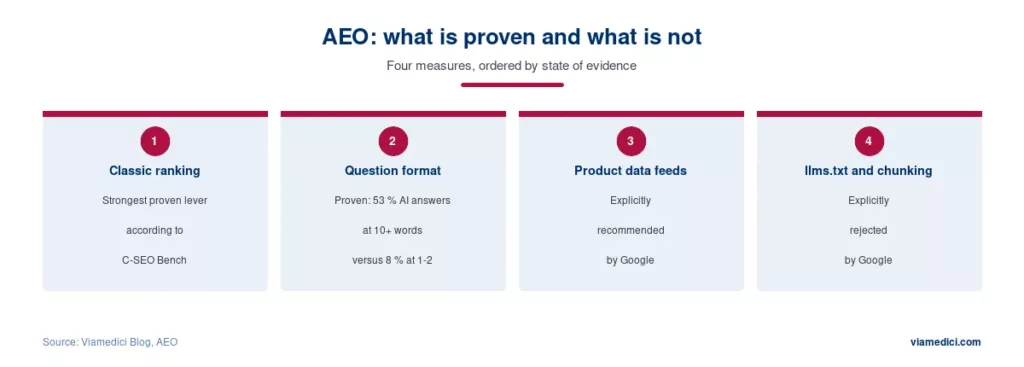
Second, the query type matters most. According to Pew, 8 percent of one- to two-word searches produced an AI summary, against 53 percent of searches with ten or more words and 60 percent of searches containing a question word. Fully formed questions trigger AI answers.
Third, many marketed tactics do not work. Google states that optimising for generative AI search is still SEO and explicitly rejects several popular recommendations, among them creating special machine-readable files such as llms.txt and splitting content into small chunks for AI (Google Search Central). The C-SEO Bench benchmark, published at NeurIPS 2025, concludes that most methods marketed as GEO are ineffective and in some cases harmful (arXiv 2506.11097).
FAQ schema and the question-and-answer format
Nearly every AEO guide recommends FAQ schema. Google restricted FAQ rich results to government and health sites in August 2023 and has since retired them, and it states that no special schema is needed for AI answers. The markup can stay in place harmlessly, but it achieves nothing in Google Search. The question-and-answer format itself remains right, for a different reason: a question as a heading with a concise direct answer matches exactly the query structure that triggers AI answers. The benefit lies in the format, not the markup. That applies to product content as much as to articles.
How a PIM system supports AEO
If AEO for product vendors is mainly a data question, the PIM is where it gets solved. A PIM system supports AEO in three ways.
It holds each product fact once and distributes it to every channel, so website, shop, marketplaces and distributor feeds carry the same values. That is the precondition for consistent answers.
It checks data before publication rather than after. Useful checks before product content goes out to channels that AI systems read:
- Completeness per channel and product group, measured as a percentage, not as a feeling
- Conformity with value lists and units, so that no free text slips into comparable attributes
- Presence of use-case and compatibility attributes for the product families where buyers ask about them
- Validity of certificates and approvals, including expiry dates
- An approval step with a named owner before a change reaches external feeds
And it handles multilingual and multi-market data. Answer engines answer in the buyer’s language and market. Attribute values should therefore be stored language-independently and translated centrally, and market-specific information such as approvals, certificates, units and availability has to be maintained per market. A product that is approved in Germany but not in the US must not be described as available everywhere.
Writing product content AI can extract
Product descriptions still matter, but their job changes. They are read less by people scanning a page and more by systems summarising it. For product experience management, that makes answer engines a channel with requirements of its own. A few rules make that summary accurate:
- Say in the first sentence what the product is and who it is for.
- Put specifications in tables or attribute lists, not in running text.
- Name use cases and limits explicitly, including what the product is not suitable for.
- State compatibility directly: compatible with X, not with Y.
- Use the same terms as the attribute names, not a new synonym on every page.
- Answer the real customer questions in Q&A form, taken from sales, support and search data.
What manufacturers should actually do
- Do not neglect classic ranking. A page that is not indexed or not snippet-eligible cannot be considered for any generative answer.
- Measure attribute completeness per target channel, regularly and as a number.
- Standardise rather than phrase. Standardised attribute values instead of free text, so that models can compare rather than guess.
- Eliminate contradictions across channels. If website, shop and distributor feed carry different values, that is a data governance issue, not a marketing one.
- Check every AEO recommendation against the current state of play before paying for it.
How to measure AEO success
Google provides a generative AI performance report in Search Console, the only source based on actual Google data. Google explicitly warns against trusting third-party tools that promise access to internal ranking or AI systems.
For models outside Google there is no official measurement, but three signals can be tracked without a tool. Citations and mentions: ask a fixed set of realistic customer questions in ChatGPT, Perplexity and Copilot every month and record whether and how your products appear. Referral traffic: segment visits from chatgpt.com, perplexity.ai and similar sources in your analytics. Accuracy: check whether the specifications named in those answers are correct. For product vendors, a wrong answer is a worse result than no answer.
How AEO is likely to evolve
The next step is already visible. Assistants increasingly query product information directly, through feeds, APIs and interfaces such as MCP, and in some cases act on it in the buying process. What that means for B2B is covered in our article on agentic commerce, and how AI systems can be connected to company data in a controlled way in the article on the MCP server in the PIM context. For product data strategy that means treating machine-readable channels as primary channels, not as an export at the end of the process. Which AI functions in PIM are sensibly automatable today is set out in the article on AI in PIM.
Conclusion
AEO describes a real shift in user behaviour but not a new discipline. Google itself classifies optimising for generative search as search engine optimisation, and research finds little effect for many of the tactics sold under the label. For manufacturers and distributors the lever that decides visibility in AI answers is product data: complete attributes, consistent values across every channel, standardised units and value lists, and explicit statements on use cases and compatibility. Companies that manage this in one governed source are well positioned for AEO and GEO alike, whatever the acronym turns out to be next year.
Frequently Asked Questions About AEO
AEO stands for answer engine optimization and describes measures intended to make content visible in direct answers, whether in AI Overviews, ChatGPT or Perplexity. The term has no defined originator and is used inconsistently across the market.
In practice, very little. GEO (generative engine optimization) traces back to a 2023 research paper, while AEO is a marketing coinage. Both describe the same objective. The technically meaningful distinction runs between extractive answers drawn from one source and generative answers that synthesise several.
Because they compare products on attributes and can only use information that exists in machine-readable form. A model does not test a product; it combines what the vendor and its channel partners have published. Structured attributes with units and value lists can be compared reliably, free text cannot.
The exact logic is not published. What is known: a source first has to be retrieved, from the search index or from product feeds, and generative answers then combine several sources. Products with complete, consistent attributes that match the question, and that are described the same way across channels, give a system the least reason to leave them out.
The ones buyers ask about: technical specifications with units, use cases and limits, compatibility with other products, and the differences between variants of a family. Use-case and compatibility attributes are the most commonly missing ones.
A PIM system holds each product fact once and distributes it consistently to website, shop, marketplaces and feeds. It checks completeness and value-list conformity before publication, manages translations and market-specific data centrally, and makes the owner of each attribute visible.
Not for display in Google Search. Google has retired FAQ rich results and states that no special schema is required for generative search. The question-and-answer format still makes sense, because of the text structure rather than the markup.
No. Google explicitly classifies optimising for generative search as search engine optimisation. A page has to be indexed and snippet-eligible to be considered for an AI answer at all.
Through the generative AI performance report in Google Search Console, plus monthly spot checks with a fixed set of customer questions in ChatGPT, Perplexity and Copilot, referral traffic from those sources in your analytics, and a check of whether the specifications named in AI answers are correct.